Share it! Science : vegetables
Showing posts with label vegetables. Show all posts

Grow an Alphabet Themed Kid's Garden!

A is for Aster and B is for Basil. Can you grow an alphabet in your garden? Here are some ideas for a themed children's garden for school or home.

Why not incorporate some literacy into your garden planning this year? Gardening already has so much potential for science and life lessons. This will be the third year we've shared an idea for a themed children's garden along with a seed giveaway. We're so excited to be able to do it again. No matter how you get gardening with kids, we believe it will be a rewarding experience.  

This post contains affiliate links, meaning I earn a small commission from purchases made from these links at no additional cost to you. Please see disclosures for more information.
 

Plan and grow an alphabet themed kid's garden! Literacy and science


Grow An Alphabet Themed Garden

For those of you with lots of space, you might be ambitious enough to try a garden with every letter of the alphabet. If you are starting seeds in the classroom, you could have each student take on a different letter. Or you could pick and choose from a few letters of the alphabet.


Here are some fruit/vegetable and flower ideas to get you started (please note: depending on where you live these may or may not be good choices for your garden, do your homework!):

A- Arugula, Aster
B- Beans, Bee Balm (Monarda)
C- Carrots, Cosmos
D- Dill, Daisy
E- Eggplant, Echinacea
F- Fennel, Forget-me-not
G- Gourds, Geranium 
H- Honeydew melon, Hollyhock
I- Iceberg lettuce, Impatiens 
J- Jerusalem artichoke, Johnny Jump Up
K- Kale
L- Lettuce, Lupine
M- Musk melon, Marigold
N- Napa cabbage, Nasturtium
O- Okra, Oenothera biennis (common evening primrose)
P- Peas, Petunias
Q- Quince, Queen Anne's Lace
R- Radish, Rose
S- Spinach, Sunflower
T- Tomato, Tulips
U- Upland Cress, Ursinia
V- Verbena, Viola
W- Watermelon, Wallflower
X- Xeranthemum
Y- Yarrow
Z- Zucchini, Zinnia (find out how to win some Zinnia seeds below!)


Grow a Kid's Name Garden

Spell out a name with garden plants. If I did mine I might plant Spinach, Artichokes, Radishes, Arugula, and Honeydew to spell out SARAH. You could certainly get creative and use the common names or specific variety names to spell out just about anything you wanted. Make some cute garden markers to go along with your name garden.

Looking for other themed garden ideas? Grow a butterfly or rainbow garden. Try growing a taco or pizza garden!

Seed Giveaway!

Now for some fun. We are very excited to have Renee's Garden provide us with seeds for our third annual garden seed giveaway. I love to use Renee's Garden seeds as they are certified organic and you can find interesting varieties of heirloom plants and unique seeds that can be grown on trellises or in containers. You're sure to find plants you don't see elsewhere when you shop their seeds!

We'll get you started on your alphabet garden adventure with some heirloom "State Fair Gold Medal" and "Cut and Come Again" Zinnia seeds from Renee's Garden seed company. 8 winners will receive two packets each of these zinnia varieties (for a total of 4 seed packets per winner). Enter in the Rafflecopter box below. We'll notify winners by e-mail, so be sure the one you've given Rafflecopter is the best way to reach you!

a Rafflecopter giveaway
Disclaimer: Renee's Garden seeds donated all prizes for this giveaway, and I am a member of their affiliate program, but I was not otherwise compensated by Renee's Garden to write this post.


25 Weeks in the Garden, An Autumn Round-up

We've had a couple of hard frosts, so there is no question that the growing season is finished! It's always a bittersweet time for me, as I pull up the plants in our garden to clear it out for the winter. It gives me a chance to reflect on what worked and what didn't and look forward to trying again next year!

I always learn so much from the garden each year. New plants, new insects, new success and failures. Let's take a look back at 25 weeks in the garden and start dreaming about what we might plant next spring!

April 1st, 2015: No Foolin' 
April 10th, 2015: Week 2 (The first sprouts)
April 15th, 2015: Crocus and Strawberries

Crocus ©SBF
April 24th, 2015: A Splash of Yellow
April 30th, 2015: Perennials Popping Up
May 6th, 2015: April Showers Bringing May Flowers

http://www.shareitscience.com/2015/05/glimpse-of-garden-week-6-april-showers.html

http://www.shareitscience.com/2015/05/glimpse-of-garden-week-7-seed-potatoes.html May 13th, 2015: Seed Potatoes
May 21st, 2015: Onion Sets

May 29th, 2015: Preparation and Procrastination
June 3rd, 2015: The First Pest Problems

http://www.shareitscience.com/2015/06/glimpse-of-garden-week-10-first-pest.html

June 10th, 2015: Tortoise Beetles!
June 18th, 2015: Pollinators and Wild Strawberries
June 26th, 2015: The Golden Ratio in the Garden

http://www.shareitscience.com/2015/06/childrens-steam-festival-golden-ratio.html

July 3rd, 2015: Green Galore!
July 10th, 2015: Much Ado About Mulch
July 18th, 2015: Tendrils-Plants in Motion


http://www.shareitscience.com/2015/08/glimpse-of-garden-week-20-insect-mystery.htmlJuly 24th, 2015: Isn't Summer Delicious?
July 31st, 2015: Lovely Lilies and Gorgeous Gourds
August 7th, 2015: Tomato Blossom End Rot...and Other Adventures
August 14th, 2015: An Insect Mystery
August 20th, 2015: Insect Mystery Revealed!


August 27th, 2015: Lemon Cucumbers
September 3rd, 2015: Small Potatoes

http://www.shareitscience.com/2015/08/glimpse-of-garden-week-22-lemon.html


September 9th, 2015: Lessons from Sunflowers 
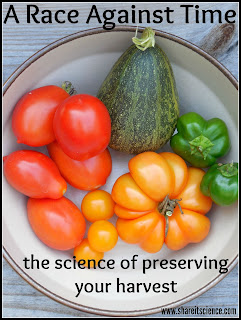
September 18th, 2015: A Race Against Time- The Science of Preserving Your Harvest

http://www.shareitscience.com/2015/09/glimpse-of-garden-week-24-lessons-from.html 
 http://www.shareitscience.com/2015/09/glimpse-of-garden-week-25-race-against.html

What will you plant next year? Gardening with kids? Do you have a school garden? Share your ideas! Comment below or connect with us on Facebook or Google+

(affiliate link)
Homegrown Collective

Glimpse of the Garden: Week 25, A Race Against Time

'Tis the season for harvesting fruit and veggies. Maybe you are overrun with tomatoes or squash. What is the best way to preserve your harvest before science takes over and those beautiful veggies start to spoil? Luckily, there are several options depending on the amount of time you have to do it, and your level of expertise.

Harvesting your garden is also a great kid's activity. Kids love digging potatoes, harvesting popcorn, and pulling carrots. There is also a ton of science involved in food preservation, including concepts like: pressure, vacuums, bacteria, decomposition, life cycles, etc. There are so many ways to make this type of work a fun, learning experience for you, your students or children.


This post contains affiliate links, see disclosures for more details.

Tomatoes on the window seat, tomatoes on the counter, tomatoes in the freezer and tomatoes on the vine. I would love to make some pasta sauce with those beautiful Romas and San Marzanos, dice up the Costolutos and put them in jars. I would even like to roast some cherry tomatoes and pop them in the freezer for a mid-winter treat. I know what you are thinking, "Well then, less talk, more action!". Alas, you need a critical amount of tomatoes of each type before you begin to can, blanch, freeze or dry and they don't all ripen at once.
©SBF 2015
Gardening is part patience, part intense action. Here we are at week 25 of my garden adventure for 2015 and I've waited patiently for this moment to come. Once your produce is ready there is only a small window of time before it becomes overripe, or an opportunistic woodchuck, chipmunk or rabbit comes along...instead of "hurry up and wait" we're playing a game of "wait and hurry up".
©SBF 2015
So what is the rush? How can you preserve your beautiful produce to save for later instead of eating salads for the next 3 weeks? Why do you need to process it, heat it to a certain temperature, freeze it solid or dry it out?

Microbes


Microorganisms, such as bacteria, are ready to do their part in the decomposition portion of your plant's life cycle. The plant grew your produce as a way of disseminating its own seeds, not as a kind gesture or repayment for watering it all summer. Once it has grown its fruit, eventually it will spoil. Bacteria are everywhere, and can be helpful or harmful to humans. Many of the bacteria you find in ripening and rotting veggies are not the helpful kind!
©SBF 2015

How Can You Preserve Your Harvest? 


Drying or Dehydrating


Drying foods to preserve them was most likely another happy accident. The sun and wind are pretty good dehydrators. Most microbes that cause disease enjoy a moist environment to multiply in. When food is dried out it becomes an inhospitable place for those types of bacteria. You can dry produce in your oven or in an electric food dehydrator. Check out the Colorado State University Extension page for more information on drying and dehydrating your own vegetables. Electric food dehydrators can also be purchased fairly inexpensively.


Blanching and Freezing


Freezing veggies is a quick and fairly easy option to preserve them for later use. Before you freeze vegetables you should blanch them. Blanching is a process in which you heat the vegetables for a short period of time in boiling water. They are then removed and placed in an ice bath to stop the cooking process.

Blanching breaks down the enzymes that are at work ripening your food. The boiling action also helps to kill any microorganisms on the food. The blanched vegetables can then be placed in freezer bags or containers and frozen for longer periods of time. Different vegetables have different blanch times. See this link for the appropriate times for different types of produce.


Canning


Although a little more labor intensive, canning is one of my favorite ways to preserve food. If you follow a recipe and work carefully then the result is safe, well preserved food that looks awfully pretty in a jar, too. I use a heat bath canner. Basically this means that after your jars are packed you boil them for a certain amount of time to destroy any harmful microorganisms and to vacuum seal your jar shut.


Recipes for canning fruits and veggies will help you to determine if you need to add anything acidic to the jars to help preserve the food. Lemon juice and citric acid are common natural additives to preserving food canned at home. Microorganisms cannot tolerate acidic environments. I will be chronicling the process of canning my tomato sauce for you in a future post- stay tuned. For some great tips and recipes for canning, you should visit the Pick Your Own site.

For tried and true canning recipes, I recommend  Ball Complete Book of Home Preserving


©SBF 2015


I'm excited this year to have produced enough tomatoes to make some sauce and can it for the winter. Slowly but surely, the tomatoes are ripening (I need 10 lbs of them). We're almost there, just some more patience. Then someday soon the tomatoes will be ripe and they will no longer wait. Time for that intense action I spoke of earlier. I will begin the job of blanching and peeling and cranking the food mill. I'll slowly simmer the sauce and then pack it into jars and put them in a hot water bath. It will be hours of work, but well worth the effort, the patience and time. 

More on the science behind food preservation:

Elevated Raised Beds

Glimpse of the Garden: Week 23, Small Potatoes!


We harvested our "trash can" potatoes. Not the biggest yield, but we enjoyed some in the oven with some shallots, garlic and olive oil. YUM! Everything tastes better when you grow it yourself. 

Red and white potatoes. ©SBF 2015

You may remember planting these potatoes back in May, "Glimpse of the Garden: Week 7, Seed Potatoes".

Harvesting from containers is easy. We spread out a tarp, and then dump out the contents! 


Finding the potato treasures is the fun part. This step is what makes growing potatoes with kids a great project, they love to dig around in the soil!


The all red variety was a beautiful magenta color.


This year my potato plants did not blossom and were sort of spindly. I'm not sure if this had to do with the weather or some larva we found in one of the trash cans. Hopefully next year will be better! 


At risk of sounding like a broken record, for this and other great container gardening ideas check out my favorite small-scale gardening book: Grow Great Grub: Organic Food from Small Spaces (affiliate link)

What are you harvesting? What is your favorite way to enjoy potatoes? Comment below or share on our Facebook or Google+ pages.

(affiliate link)
Grow and Make

Glimpse of the Garden: Week 22, Lemon Cucumbers


I love growing plants in containers because it saves space and helps in a yard with limited direct sunlight. It is also makes gardening with kids a little more accessible.

This post contains affiliate links, please see disclosures for more information. 

One of the container plants we have enjoyed growing the past 2 summers are heirloom Lemon Cucumbers. This year I have a bumper crop, which is nice because my other plants haven't been super productive! 

Lemon Cucumber on the vine. ©SBF 2015
Lemon cucumbers are named for their shape, not their taste. They are round palm-sized cucumbers that can easily be eaten in one sitting. They taste like any other cucumber, not too sweet and in my experience never bitter. They are an excellent choice for the garden if you are gardening with kids!

Personal sized cucumber! ©SBF 2015
Looks like a lemon on the outside, regular cucumber on the inside! ©SBF 2015
Last year we grew them in a small pot with a little trellis. After seeing the far reach of their sturdy vines, I decided this year to give them some more space. They are enjoying the barrel planter they are in and were happy to vine up the fencing and strings that I had tied in for support. Their tendrils are beautiful and fascinating. You can read more about the fascinating science behind these cucumber tendrils in my post: "Glimpse of the Garden: Week 16, Tendrils-Plants in Motion" 

©SBF 2015


I learned about these great little cucumbers in my favorite container garden book, Grow Great Grub: Organic Food from Small Spaces.

You might be familiar with the author, Gayla Trail, from her website, "You Grow Girl". I highly suggest both the book and website if you are interested in gardening but have limited space.


This week's other garden highlights:
How is your harvest coming? Share your stories and photos in the comments below, e-mail me at shareitscience@gmail.com or share via social media with #shareitscience