Showing posts with label chemistry. Show all posts
Snowflake Crystal Solutions: A STEAM Project
Snowflakes are some of the most beautiful natural structures on Earth. Although we don't often get to see their ice crystal structures up close, there are other types of crystals that are easy for us to explore. Learn how to make some beautiful snowflake art by experimenting with household substances that have a crystal structure on my latest guest contributor post on Only Passionate Curiosity.
Exploring Melting Point: Turkey Timer STEM
It's time for a big Thanksgiving feast, and you are tasked with cooking the bird. How do you assure your Thanksgiving turkey has been cooked to a safe temperature, but is not overly dry? Science to the rescue! Here is a science investigation that will teach your kids or students about melting point, materials science, and product design.
If you've cooked a turkey you've probably seen a pop-up meat timer. These nifty devices are designed to pop up when the bird is done. But how does it work? This STEM investigation will answer that question and give the kids something to do while you're busy in the kitchen preparing for the feast.
Every element of the periodic table has a melting point and a boiling point. These are the temperatures at which the element melts or boils. When elements are combined they have different melting and boiling points. Engineers put these principles to work when designing pop-up turkey timers.
Here is the background information, or "spoiler", for this investigation. Depending on how open-ended you would like your student's or children's investigation to be, you can feel free to divulge this at the start, or let them make hypotheses of their own before sharing.
Inside a turkey timer is a thin piece of metal. The metal is a combination, or alloy, of lead, cadmium and bismuth. This alloy melts at a specific temperature, which is the same as a turkey needs to cook to, 180 degrees F, or 83 degrees C. When the piece of metal melts, the "pop-up" part of the timer is released.
If you've cooked a turkey you've probably seen a pop-up meat timer. These nifty devices are designed to pop up when the bird is done. But how does it work? This STEM investigation will answer that question and give the kids something to do while you're busy in the kitchen preparing for the feast.
This post contains affiliate links, meaning I will receive a small commission (at no additional cost to you) if you make a purchase after clicking a product link. Please see disclosures page for more details.
![]() |
| Photo by M. Rehemtulla [CC BY 2.0 (http://creativecommons.org/licenses/by/2.0)], via Wikimedia Commons |
Background Information: Turkey STEM Investigation
Here is the background information, or "spoiler", for this investigation. Depending on how open-ended you would like your student's or children's investigation to be, you can feel free to divulge this at the start, or let them make hypotheses of their own before sharing.
Inside a turkey timer is a thin piece of metal. The metal is a combination, or alloy, of lead, cadmium and bismuth. This alloy melts at a specific temperature, which is the same as a turkey needs to cook to, 180 degrees F, or 83 degrees C. When the piece of metal melts, the "pop-up" part of the timer is released.
Pop-up Turkey Timer Experiment Supply List:
- pop-up turkey timers
- water
- pan or beaker
- candy thermometer or probe thermometer
- tongs
- oven mitt or heat resistant gloves
- stove or hot plate
- a turkey! (optional for Thanksgiving day extensions)
Procedure for Melting Point Science Experiment
Using the proper safety precautions, heat some water in a pan or beaker on the stove top or hot plate. Hold the turkey timer under the water with the tongs. Insert the thermometer in the water as well. It's probably best to make this a 2 person procedure.
When the red part of the pop-up timer pops, record the temperature of the water. How accurate was the timer?
Try it again- to reset the timer, pull it out of the hot water and push down the red part. Allow to return to room temperature. This will solidify the alloy inside once again. To speed up the process, hold the timer closed in ice or ice water.
What do you find in subsequent trials? How consistent is the timer? Does it lose its effectiveness when it's been used more than once? Be sure to record all of your results.
![]() |
| by Freddyz at the French language Wikipedia [GFDLor CC-BY-SA-3.0], via Wikimedia Commons |
When the red part of the pop-up timer pops, record the temperature of the water. How accurate was the timer?
Try it again- to reset the timer, pull it out of the hot water and push down the red part. Allow to return to room temperature. This will solidify the alloy inside once again. To speed up the process, hold the timer closed in ice or ice water.
What do you find in subsequent trials? How consistent is the timer? Does it lose its effectiveness when it's been used more than once? Be sure to record all of your results.
Turkey Timer Experiment Extensions
- When you are cooking the bird on Thanksgiving, watch for the timer to pop. When it does, use a meat thermometer to check the temperature near where the timer is inserted into the bird. How does this compare to your experiment?
- Engineer your own pop-up thermometer model with this lesson idea from the National Science Teacher's Association.
You'll find some cranberry science activities here. Check out this link if you are curious about turkey genetics. Answer the age-old question: does turkey really make you sleepy?
Pickle Science with Thriving STEM
For this week's Spectacular Summer Science Series post, head on over to Thriving STEM for "How To Learn Chemistry By Making Delicious Pickles". Science is always a little more fun when you add something edible into the mix, don't you think? This is a perfect summer time family activity.
For other great summer science ideas, check out the other posts in this series and follow my Pinterest board- Summer Science!
Excited to do more science this summer? This is just one post in the Spectacular Summer Science Series! Sign up to get Share it! Science News posts by e-mail so you don't miss out!
![]() |
| www.thrivingstem.com |
For other great summer science ideas, check out the other posts in this series and follow my Pinterest board- Summer Science!
Excited to do more science this summer? This is just one post in the Spectacular Summer Science Series! Sign up to get Share it! Science News posts by e-mail so you don't miss out!
Time to Update Your Periodic Table!
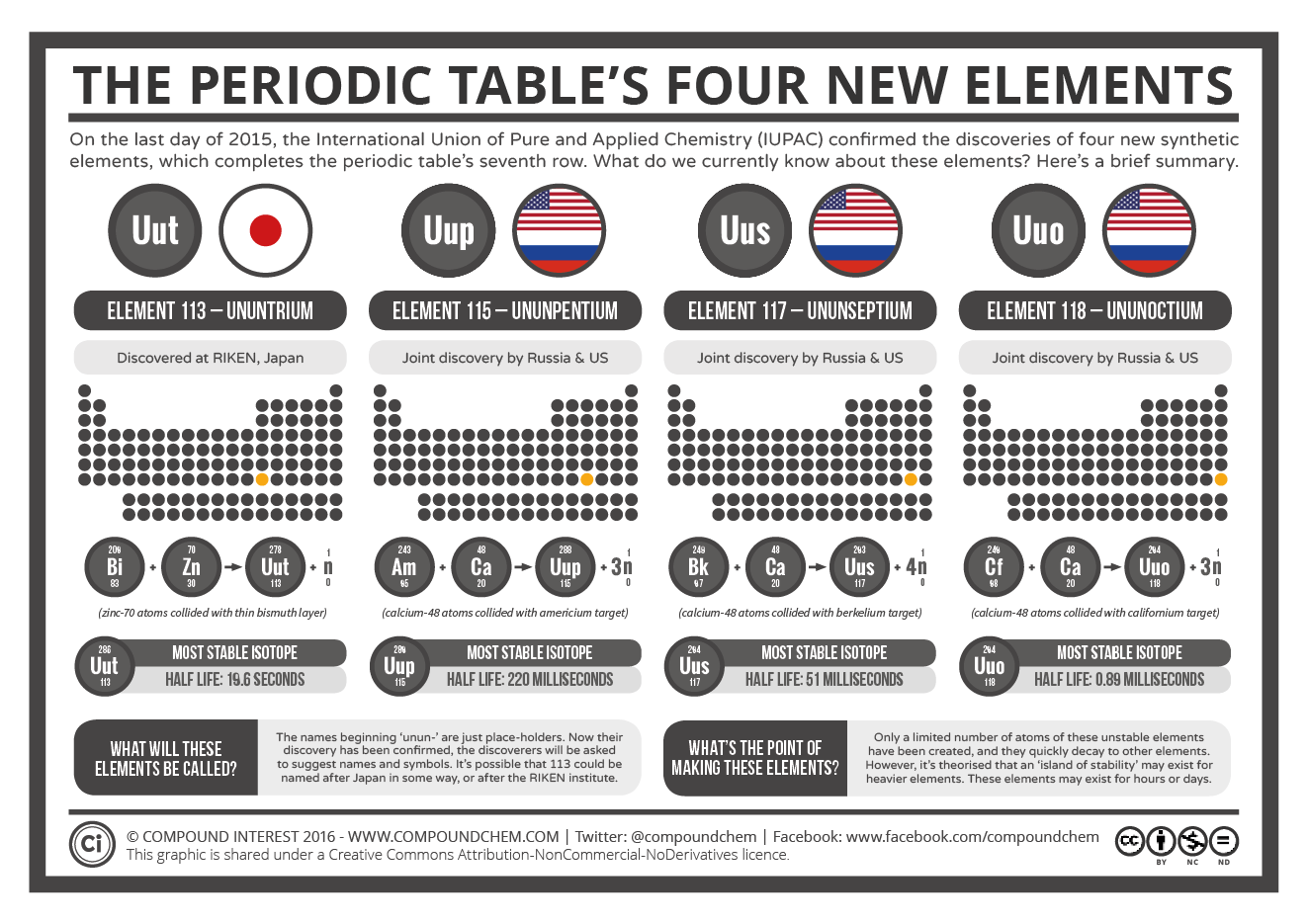
In what was a historic event for scientists, a headache for teachers and a boon for textbook publishers four new elements were added to the Periodic Table earlier this week, completing the 7th row. It is not quite time to start memorizing these new additions yet as they only have temporary names. Turns out they may not be officially named for many years due to the quirky naming process of elements!
![]() |
| By Sandbh (Own work) [CC BY-SA 4.0], via Wikimedia Commons |
The four new elements have the temporary names: ununtrium, ununpentium, ununseptium, and ununoctium, or elements 113, 115, 117 and 118 respectively. Element 113 was discovered by the Japanese at RIKEN and the other three are being claimed as joint discoveries of Russia and United States.
This infographic does a great job of summing up what we know about the new elements. Click on the image for an enlarged view.
![]() |
| © Compound Interest 2016 |
From a teaching standpoint, besides the fact that all of the periodic tables in books and on posters will be missing these new additions, the addition of these elements does not affect the basics of a high school chemistry course. As they are synthetic elements, they are not crucial for understanding the basics of chemistry. However, it is something that will need to be updated once they have their official names. What a tricky subject science is, always evolving! First all my astronomy materials were outdated when Pluto was demoted...and now this!
To read more about the new addition to the Periodic Table and some of the quirks of the elemental naming system, check out some of the links below. If you are looking for periodic table teaching resources you'll want to explore the list of over a dozen links and free apps at the bottom of my post for last year's Chemistry Week. Keep in mind that those periodic table ones might be slightly out of date at the moment!
Read more:
- Gizmag: Four New Elements Confirmed
- Quartz: The Strange Rules That Dictate How Elements Get Their Names
Resources:
- Links, apps and experiment ideas: National Chemistry Week 2015: Chemistry Colors Our World
- American Chemical Society Education Site
National Chemistry Week 2015: Chemistry Colors our World
It's National Chemistry Week! The 2015 theme for National Chemistry Week (NCW) is "Chemistry Colors Our World". There are so many great science activities that relate to this theme. How does one pare it down to something manageable during NCW? We've attempted to do that for you right here. You'll find tons of color activities, general chemistry links and recommended chemistry apps below. Read on chemists young and old!
Looking for some kid-friendly information and activities to get you started? Refer to the American Chemical Society's publication for NCW: Celebrating Chemistry.
What is color anyway? This is really more of a physics question, but it is a good place to begin before delving into color chemistry! This is a great explanatory video from Physics Girl. [This video was the 2014 winner of the Flame Challenge, a competition for scientists to answer questions understandably for kids. (btw: My sciences classes at Pine Cobble School voted for you Physics Girl!)]
So where do we see color in chemistry? Lots of places! Pigments, food coloring, pH indicators, fireworks, etc. You can find color chemistry right here on Share it! Science News. Check out these posts:
![]() |
| Leaf Pigments. ©SBF 2015 |
- Saturday Science Experiment: The Hidden Colors in a Leaf
- Saturday Science Experiment: Science with Christmas Leftovers (use Poinsettia pigments to make pH paper!)
- Saturday Science Experiment: 5 Ways to Make a Real Rainbow (physics)
- Got Milk? (Tie-die Milk activity)
Or maybe one of these color chemistry activities sounds like fun:
Add color to Steve Spangler's kid-friendly version of Elephant's Toothpaste
Try Science Bob's Rapid Color Changing Chemistry Experiment with materials you can readily purchase at the grocery store.
Or visit the Growing with Science blog's Chemistry Week page for several other fun chemistry lessons and activities!
Don't forget to practice and encourage safety! Here is some kid's safety equipment for kitchen science experiments. (affiliate links)
[Please note: take the appropriate safety precautions when working in an actual laboratory setting!]
Looking for more chemistry resources? Check out the links and apps below! Happy National Chemistry Week!
Chemistry Links:
- American Chemical Society: National Chemistry Week Education Page
National Chemistry Week Illustrated Poem Contest
American Chemical Society: High School Chemistry Education Resources - American Association of Chemistry Teachers
Chemical Education Digital Library - Chem Collective-Online Resources for Teaching and Learning Chemistry
- Periodic Table Live! (interactive on-line periodic table)
WebCQ- Interactive Periodic Table - Elements Database- Interactive Periodic Table
- Images of Chemical Elements- A Virtual Museum
- Periodic Videos
- Elements 4D (augmented reality blocks, manipulate elements to learn about real-life chemistry, requires web access) Elements 4D (iTunes App Store), Elements 4D (Google Play), Supplemental information and lesson plans for Elements 4D
- Periodic Table: EMD PTE (iTunes App Store), EMD PTE (Google Play)
- Periodic Table Lite (Interactive Periodic Table- Color coordinated by Element Group) Periodic Table Lite (iTunes App Store)
- The Elements Flash Cards (Quiz yourself on the elements) The Elements Flash Cards (iTunes App Store)
- goReact (become a chemist by combining elements and finding the product of chemical reactions!) goReact (iTunes App Store), goReact (Google Play)
- Atoms HD (atom building game) Atoms HD (iTunes App Store), Atoms HD (Amazon App Store for Android)
Explore chemistry with these great books! (affiliate links)
The World's Water Situation: A Science Demo for School or Home
Have you ever tried to reason with a kid about why they shouldn't waste water? "Why? It just keeps coming out of the faucet!" Just telling them not to waste it is probably about as effective as our parents telling us to eat our vegetables because there were starving kids in far off places. "So what? They won't get this food whether I eat it or not!"
Kids (and adults!) in developed parts
of the world often take water for granted. We are lucky, unless we
are experiencing a drought, to have a fairly consistent, clean water
supply. This is certainly not the case everywhere.
![]() |
| by Scott Robinson |
This post contains affiliate links, please see disclosures for more details.
So first, the bad news... Have you
heard about the toxic foam that forms on Bellandur Lake in India? I
hadn't until I was assigned a writing piece on it. A combination of
industrial waste and raw sewage has created a dire situation in this
lake in the highly populated city of Bangalore. For decades pollution
has been dumped in a series of canals that ends in Bellandur Lake.
The winds and rain from monsoon season just add to the problem and
make the foam build up. The foam flies through the air and builds up
on the roads slowing traffic much like a snowstorm. It is giving
people headaches, smells awful and sticks to your skin. Last May it
even caught on fire! Lack of government funds, policing and
environmental regulations prevent the problem from getting any
better. Sort of a foamy nightmare.
The good news...An incredible young
innovator has devised a plan to help clean up the Great Pacific
Garbage Patch. Boyan Slat, a young Dutch
entrepreneur and inventor, has an ingenious and cost effective plan
in action to clean up a large portion of the bits of plastic that are
floating, and breaking down, in the ocean. This plastic is slowly
making its way into the food chain and causing human health issues,
not to mention the devastation to aquatic wildlife as the trash
floats around in the water. Slat's plan uses natural circular
currents in the ocean, called gyres, to passively collect the
plastic. It is corralled and collected, then recycled into oil to
offset the cost of the collection. Amazing. Read more about his
project, The Ocean Cleanup, here in
the kid's article I wrote for DOGOnews.
So, there are negative things happening
to the world's water, and some positive efforts to make changes for
the better. The lesson for our kids is that although Earth is covered
in water, very little of it is available for us to use. That is why
we need to conserve what we have.
An effective hands-on way to show this is to do this demonstration at school or home. You can have students or your children help measure out the water in each step. Through the years I have come across many variations of this lesson. Here are two versions that I have adapted. One version is for those of you with access to science lab containers, like graduated cylinders, and the other version uses things you can more readily find around the house.
Version 1: The World's Water Demo with
Materials from the Science Lab
Supplies:
- 1000 ml graduated cylinder
- 100 ml graduated cylinder
- 10 ml graduated cylinder
- petri dish (or any dish)
- eyedropper
- water
2. Now pour 30 ml of this water into
the 100 ml graduated cylinder. This represents Earth's fresh
water. The remaining 970 ml represents the salt water in the
ocean. We can't drink salt water!
4. Carefully pour about 6 ml of the
"fresh" water into the petri dish. This represents the
fresh water that is not frozen in ice caps or glaciers.
5. Of the water in the dish less
than 1/3 represents water that is available above ground. Take an
eye dropper and remove 1 drop of water from the dish. This
represents the water that is clean, fresh, not polluted and otherwise
available to use.
Version 2: The World's
Water Demo with Materials from Home
Supplies:
- 1 gallon jug
- 1/2 cup measuring cup
- 1 Tablespoon
- eyedropper (or a straw to make a drop)
- water
1. Fill the jug with
water. This represents all of the water on
Earth.
2. Take 1/2
cup of this water and pour it into one of the clear cups. This
represents Earth's fresh water.
The rest of the water in the jug represents salt water. We can't
drink salt water!
3.
From the 1/2 cup of water in the clear cup, take 4 Tablespoons of
water and pour this into the second clear cup. This
represents the fresh water that is not frozen in ice caps or
glaciers.
4.
From the cup with the 4 Tablespoons of water, remove one drop with
the eyedropper or straw and put it in the third clear cup. This
represents the water that is clean, fresh, not polluted and otherwise
available to use.
Pretty
mind-blowing, huh? Well there is good news here and there is bad
news. The bad news is, we don't have a ton of available fresh water
on Earth, so we need to understand how precious it is. The good news
is we can teach our kids to conserve it!
For
other ways to teach water conservation and test water quality, read
my post: Science Teacher's Toolbox: Testing Water Quality
You might also want to check out Smarty Pants' TED-Ed video as a way to introduce water conservation!
Try
these books to teach about water conservation!
What's the Deal with the Nobel Prize Anyway?
![]() |
| Nobel Prize Medal image: United States Public Domain, Copyright Sweden, TM Nobel Foundation. |
There will be some big announcements in
the world of science this week- The Nobel Prizes are being awarded in
Physics and Chemistry. I am excited to see what discoveries the
winners are being honored for, although when I really think about it,
I realize that I don't really know too much about the Nobel Prize
itself or the history of the prize. Do you? I know that there is a
monetary element and prizes are given in multiple categories such as
the sciences, peace and literature...what else? I must admit, it is a
little embarrassing.
Let's save future embarrassment by
learning the somewhat quirky history of the Nobel prize, meeting this
year's science prize winners, and linking up with some lesson plans
and activities to teach about the Nobel prize. Don't worry, we'll get
through this together!
![]() |
Arthur Nobel. Public Domain- US {PD-US}
|
Alfred Nobel was a Swedish scientist
and inventor. His most famous claim to fame (besides his prize of
course) was inventing dynamite in 1867. Lore has it that upon the
death of his brother, a French newspaper published an erroneous
obituary for Alfred instead. The obituary was less than flattering,
stating that "The merchant of death is dead" in reference
to his dangerous invention of dynamite and other armaments. Realizing
that he was not a well-loved person, Alfred Nobel wished to leave a
more positive legacy. He wrote his will to leave most of his money, a
fortune amassed by investing in his brother's development of the oil
fields in the Caspian Sea, to a trust that would award the Nobel
prizes.
Nobel's will
stated that the prize
shall be given to those who, "conferred the greatest benefit to
mankind". The first of the Nobel prizes were given in 1901. The
categories for the prizes have remained unchanged since their
inception: Chemistry, Physics, Physiology and Medicine, Literature
and Peace. In 1969, the Sveriges Riksbank Prize in Economic Sciencesin memory of Alfred Nobel was added
to the list of prizes that are given each year by Royal Swedish Academy of Sciences.
Scientific discovery has certainly
evolved since the prizes began and many have called for
an update of the Nobel Prizes. Some of the arguments include
acknowledging that science involves collaboration of many people, not
only individuals, and including the many fields of research that are not
represented by the three current science prizes.
In this episode of "It's Okay To Be Smart" Joe Hanson humorously
describes some of the ways the Nobel Prize could be updated. (Please
preview before showing to students)
The 2015 winners of the Nobel Prize in Physics, announced today, October, 6th 2015, were Takaaki Kajita from
the University of Tokyo in Japan and Arthur B. McDonald from Queens
University in Kingston, Canada. They shared the prize they were
awarded for the discovery of neutrino oscillations, showing that
neutrinos have mass.
Now for those of you who know you've
heard the word neutrino before but don't quite have a handle on what
it means (I'm raising my hand) here is a brief explanation:
Neutrinos are very tiny particles that
move close to light speed. They are one of most common particles in
our Universe, but are not well understood. They are often called
"ghost particles" because they barely have a charge or
mass. Despite this, they are one of the universe's basic ingredients.
You have thousands of them inside your body. Learning more about
neutrinos allows physicists to understand some of the most
fundamental questions in physics.
To better understand neutrinos and the
scientists that won the Nobel Prize for studying them, visit this
page to read more.
Now that you (and I) understand more
about the history of the Nobel Prize, there are many avenues
available for teaching and learning. There is certainly a long list
of notable scientists, and those who have been snubbed throughout the years to
discover in a science class. There are some interesting questions
about human character inherent in the story of Alfred Nobel that
could be fun to explore in a history, ethics or writing class.
Don't you feel better informed now? I
know I do!
Some good books for learning about the
Nobel Prize:
(affiliate links, click images for book details)
Lesson plans, links and information
about the Nobel Prize:
- Educational materials from Nobelprize.org
- Variety of Nobel Prize Lesson Plans-Lesson Planet
- Was Nobel Noble? Meet the Man, grades 6-8
- BrainPop- Nobel Prize Lesson Ideas
Science Teacher's Toolbox: Testing Water Quality
Water is one of our most precious resources. The Earth is about 71% water, but not all of it is readily available and safe for us to drink. There are many ways to teach your students and your own children about water conservation. From the water cycle, to strategies to conserve water and water quality testing, there are tons of learning opportunities here.
Testing water quality is a great way to engage students in collecting data and contributing to science at a local and global level. This type of project is certainly not just for school, it could be done at home, in an environmental club, summer camp, etc.
This post contains affiliate links, meaning I will receive a small commission (at no additional cost to you) if you make a purchase after clicking one of these links. Please see disclosures for more information.
You don't need any high tech equipment to do this. Find a vernal pool, stream, pond, etc. and bring along a kitchen sieve, a spoon and a small paintbrush. Remember- these creatures can be sensitive and fragile, or water predators with pincers, so you don't want to grab them with your fingers!
If you fill a basin with some of the water from the area you'll have a place to observe what you find. Scoop up water, leaf litter and debris with the sieve. Very carefully look through the litter to find these tiny creatures. Lightly brush them onto your spoon and dip the spoon into the water in the basin. What have you found?
Testing water quality is a great way to engage students in collecting data and contributing to science at a local and global level. This type of project is certainly not just for school, it could be done at home, in an environmental club, summer camp, etc.
This post contains affiliate links, meaning I will receive a small commission (at no additional cost to you) if you make a purchase after clicking one of these links. Please see disclosures for more information.
Water Quality
It is easy to get involved in a global water quality testing project through the EarthEcho Water Challenge (formerly the World Water Monitoring Challenge). This is an international citizen science project where groups and individuals complete basic water quality tests on local bodies of water and contribute their findings online. I have had years of success in the classroom with this reasonably priced water testing kit. You can purchase them right on Amazon here.
If you
do not have experience testing pH, dissolved oxygen, turbidity or
temperature of water I would highly recommend these easy to use kits
and resources! As this program has grown they have included many
educational resources. You can find water quality lesson plans here.
I have used these kits as an
introduction to water quality with my students in our classroom
aquarium and then outside in a local stream and some human-made
ponds. The kids enjoy doing the tests and really take ownership over their
data collection as they know they are reporting it to the EarthEcho Water Challenge.
If you are a teacher developing an
entire unit around water quality or just want to dive deeper into
understanding the topic, you'll want to spend some more time
investigating pH, learning where our drinking water comes from and
maybe even collecting macroinvertebrates to gauge ecosystem health!
Testing pH
pH is a fun chemistry topic to study
with upper elementary through high school age students. At least once
a year I get out the red cabbage to create a pH indicator solution
with my students. We test all sorts of household liquids for acidity
and basicity.
Cabbage contains pigments that work as indicators of pH. Some people boil the
cabbage, but I've found that tearing some up and putting it in a
blender with some water does the trick. I've also had kids grind the
cabbage leaves with some water in a mortar and pestle, which they
think is fun. With some clear cups and eye droppers or pipettes you
can test the pH all sorts of solutions. I avoid anything too harsh, but
there are many things right in the kitchen that work well- dish soap,
baking soda water, salt water, vinegar, different juices, etc.
For a great summary of pH and a few different ways to test it, check out this great post on Growing with Science. You can also make your own pH paper out of red poinsettia leaves if you are trying this around the holiday season. Learn how in my post, "Science with Christmas Leftovers".
You can use pH paper, or litmus paper,
to test the pH of liquids and if you wish to go high-tech there are
meters and probes you can purchase fairly inexpensively by clicking the links or checking out the Amazon widget below. There are many ways
to do a pH experiment, most likely you have what you need right at
home!
Drinking Water
Depending on the age group of the
children you are working with and their prior knowledge you might
want to investigate where your drinking water comes from. It could be
a reservoir or well, or maybe even spring fed! If you cannot visit a
water treatment plant, you can at least show students the process. I
use this short clip from PBS LearningMedia's collection. It is from
an episode of Zoom where they visit a water treatment plant.
Collecting Macroinvertebrates with Kids
One of the most exciting water quality
activities to do is to collect and identify macroinvertebrates. These
are the sensitive insects, larvae, worms, etc. that live in wetlands
and waterways. Depending on what you find, you can determine the
health of the water.
You don't need any high tech equipment to do this. Find a vernal pool, stream, pond, etc. and bring along a kitchen sieve, a spoon and a small paintbrush. Remember- these creatures can be sensitive and fragile, or water predators with pincers, so you don't want to grab them with your fingers!
If you fill a basin with some of the water from the area you'll have a place to observe what you find. Scoop up water, leaf litter and debris with the sieve. Very carefully look through the litter to find these tiny creatures. Lightly brush them onto your spoon and dip the spoon into the water in the basin. What have you found?
| Dragonfly Nymph [image: Totodu74 [Public domain], via Wikimedia Commons] |
To help you determine
what you've collected and what it means download an identification
key. These creatures are organized into three groups based on their
tolerance to pollution. You can find charts to help you determine
which group your species are in.
Here are some good examples:
Citizen Science
Water quality is a great way to get
involved in citizen science and local environmental monitoring.
Whether you participate in the EarthEcho Water Challenge or find another
local project it is an excellent way to get kids involved in an
authentic science project.
- EarthEcho Water Challenge
- PBS LearningMedia- Zoom Visits the Water Treatment Plant
- Bugs Don't Bug Me- Macroinvertebrate Lessons and Activities
- Macroinvertebrate Key
- Macroinvertebrates for Kids
- Macroinvertebrate Unit Study
Subscribe to:
Posts (Atom)