Share it! Science : biology
Showing posts with label biology. Show all posts

Surviving Like a Shark Energy Transfer Game

Kids love sharks! In this post you will find a book recommendation for a hilarious, yet factual, children's book about sharks, and an active science modeling activity for exploring the lives of sharks and the movement of food energy through an ecosystem.

Both the kid's book and science activity are great for your upper elementary school-aged kids at home or the students in your classroom. The modeling activity will get kids moving while building understanding of trophic pyramids and food chains.

If you are a teacher aligning your lesson plans with the Next Generation Science Standards, you will also find links for standards that this activity will help you meet.

Shark Science Food Chain Energy Activity

This post contains affiliate links, meaning I will receive a small commission (at no additional cost to you) if you make a purchase after clicking a product link. Please see disclosures page for more information.

How to Survive as a Shark 


First of all, a read-aloud of Kristen Foote's How to Survive as a Shark is a must. This funny children's book, illustrated by Erica Salcedo, includes science facts about the life of sharks, white sharks in particular, their important place in the ecosystem, adaptations and more.
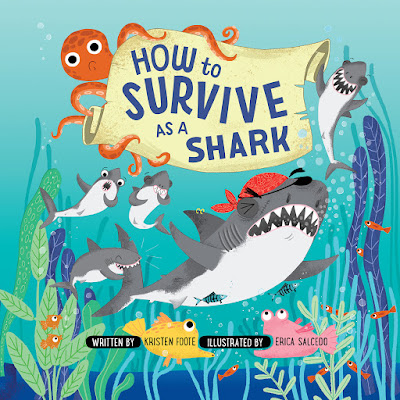
https://amzn.to/2LZaY6f


This book is perfect for upper elementary students. They enjoy the humor and understand the science. Even the kids who think they are too old for picture books get a kick of this one! The end of the story includes some discussion on what was realistic and what was fictionalized for the sake of presenting the information in the style of a humorous picture book. It is an all around great book for home or the classroom!

If you are reading How to Survive as a Shark as an intro to the activity outlined below, the strongest tie-in to the food chain and energy transfer is the discussion and illustration of the food pyramid (or trophic pyramid). In this story, white sharks are the apex predator. Depending on the species of shark, sharks may not always at the tippy top of their food chain. The food pyramid, discussion of the different levels of consumer and apex predators is a great introduction to the energy transfer activity below.


Shark Energy Activity


There are many food chains and food webs in any ecosystem, including the ocean. Energy moves through these ecosystems in the form of food. The active food chain activity outlined below allows students to model the transfer of food energy throughout a system and see it move first hand.

Shark Food Chain Science Activity NGSS aligned

For this activity you will need:


Model Energy Transfer in the Ocean


Set up the game: 

Split the group of kids into thirds. One group will be the "sharks", one group will be "large fish", and the last will be "small fish". [Note: if you are studying a specific type of shark, adapt the game to be specific to that species, i.e. "large fish" might be "tuna" or "seals" instead.]

Assign each of the groups a different color. This will be the color of the bandana that they will tie around their arm to denote their role in the activity.

Give each student a paper bag or envelope, which represents their stomach.

After assigning some boundaries for the play area, spread out the colored paper squares evenly throughout the area. These represent "plankton" in the activity.

How to Survive as a Shark illustrated by Erica Salcedo Science Activity

Game play: 

The goal of the small fish is to collect as much plankton as possible and put it in their stomachs.

The goal of the large fish is to eat the small fish, by gently tagging them, and transferring all of the plankton paper squares from the stomach/bag of the small fish to their own.

Similarly, the sharks will eat the large fish by gently tagging them, and transferring all of the plankton paper squares from the bag of the large fish to their own. (In reality, sharks may also eat small fish, but for simplicity's sake they will not in this simulation.)

Give just a few minutes (no more than 5) for game play. In order to have survived the round, small fish must have 5 plankton in their stomachs, large fish must have 10 plankton in their stomachs, and sharks must have "eaten" at least one large fish with 10 plankton in its stomach.

Write down how many of each animal survived after each round for graphing and data collection extensions.

How to Survive as a Shark illustrated by Erica Salcedo Science Activity

Wrap it up:

Be sure to discuss the results of the modeling activity.
Guide your discussions with questions such as:
  • What trends do kids notice? 
  • How is this activity realistic or unrealistic?

Create a data table or graph the results. Introduce the idea of a trophic, or ecological, pyramid and show how the amount of energy changes as it moves through the ecosystem.

Ecological Pyramid


Extend the Energy Transfer Activity


To continue modeling important ideas around energy transfer and balanced ecosystems, see what happens when you change the rules of the game. Try these adaptations of the simulation and discuss the results with your kids or students:

  • Change the number of sharks / small fish / large fish 
  • Set out more "plankton"
  • Release the small fish first, then the large fish, and eventually the sharks
  • Set up a "safety zone" for fish


Align with the Next Generation Science Standards


This activity fits with the following 5th grade science standards:

Additional Energy Transfer and Food Chain Book Recommendations 


Teaching about ecosystems is one of my favorite topics. If you are looking for other great books to share on the subject of energy transfer and food chains, you will definitely want to get your hands on a copy of Pass the Energy, Please! and The World of Food Chains with Max Axiom: Super Scientist.

I love Pass the Energy, Please! because of it's rhyming text and beautiful illustrations. Although it is a rhyming picture book, the vocabulary used is at an upper elementary level. The World of Food Chains with Max Axiom: Super Scientist appeals to upper elementary readers because it is written and illustrated in a graphic novel style.


Ocean Learning Activities


Ocean Science STEM Activities

If your kids love learning about the ocean, then you won't want to miss these other fun ocean-themed science activities!

Experiment with fizzing sea shells in this activity on the Teaching Without Chairs blog, and recreate the layers of the ocean with this density activity over on From Engineer to Stay at Home Mom.

More Shark STEM and Science


Shark Week Science and STEM activities

Can't get enough shark science? Same here. Check out these AMAZING shark eggs we saw at the Shedd Aquarium.

You'll find a bunch of shark STEM activities here, particularly fun for all of you "shark week" fans.

Want to know how sharks float? You'll find a cool hands-on shark experiment here

Go visit some real sharks at an aquarium! Find out why we love the New England Aquarium and the Shedd Aquarium.


Buy a Book and Help a Good Cause


You may not be aware of this, but when you purchase a book published by The Innovation Press, like How to Survive as a Shark or How to Survive as a Firefly, you are not only getting a great book for the children in your life, but also helping others. For every 10 books sold, The Innovation Press donates one book to First Book, getting books into the hands of kids and schools in need.


Thanksgiving Dinner Trophic Pyramid Activity

Those school days before a break, holiday or vacation can be pretty exhausting for a teacher. The kids are excited and wiggly (can you blame them?) The teachers are running out of steam. There are often special assemblies, field trips and other things that make the normal schedule not so normal, adding to the fun. It is an uphill battle!

When I was teaching during chaotic times like these I tried to find a way to create activities that still allowed for learning but were not too vexing for the students or myself. The day before Thanksgiving was one of these times! 

I would teach a unit on ecosystems with my fourth graders, including food webs, chains and trophic levels. To wrap this up before we took a few days to stuff ourselves with turkey I liked to do this easy "Thanksgiving Dinner Trophic Pyramid" science activity. It really illustrates that humans also consume more at the lower levels of the energy pyramid, just as in any ecosystem.

This post contains affiliate links, meaning I will receive a small commission (at no additional cost to you) if you make a purchase after clicking a product link. Please see disclosures page for more details.


Materials for Thanksgiving Dinner Trophic Pyramid

You will need:

Background Information for Trophic Pyramid Lesson

A trophic pyramid, also known as an ecological pyramid or energy pyramid is a graphical representation of food energy levels in an ecosystem. In other words, who eats who and how energy moves up the food chain. The widest part of the pyramid is made up of plants, the narrow point at the top is reserved for the top predator/carnivore. For more background and an activity to learn about trophic pyramids, check this lesson out.

A great book for learning about how energy moves through an ecosystem or food chain is: Pass the Energy Please! by Barbara Shaw McKinney. It's great for a read-aloud (even to early middle-schoolers) or as inspiration for writing and illustrating food chain rhymes.

Thanksgiving Dinner Trophic Pyramid Activity


Draw a very large triangle on the white board, or mark off a triangle on the floor with tape. Give it 4 sections, labeled from bottom to top: "Producer", "Consumer-Herbivore", "Consumer-Omnivore/Carnivore", and "Apex or Top Predator".  You can also get the printable version of the trophic pyramid here.

Give students three 3x5 cards, or post-it notes. Instruct them to draw and label something they like to eat or drink on Thanksgiving on each card. They will then tape their card up in the part of the pyramid they believe it belongs in: "Producer", "Consumer-Herbivore", "Consumer-Omnivore/Carnivore", and "Apex or Top Predator".

Some might fit in more than one category based on ingredients. In general all plant-based items should go in the "Producer" section, any animal products will go in the "Consumer" sections, based on what type of animal. Most likely for your purposes, you won't have anything that goes in either "Consumer-Omnivore/Carnivore", and "Apex or Top Predator" sections.

When finished discuss what they notice about the diagram. For sample questions, download the Thanksgiving Trophic Pyramid lesson plan here. 

More Food Science Activities for Thanksgiving 

Try these other fun science activities with your children or students in November: 


Communicate Like a Firefly: Light-up STEM Project

Just about everyone finds fireflies alluring and magical. In this post I'm excited to not only share a fabulous, funny and scientific new children's book all about fireflies, but also a free language arts and science printable activity and a STEM activity that combines firefly communication, life cycles and electric circuits for some light-up fun!

If you are a teacher or a parent, there is bound to be something in here that keeps your children or students engaged and gets them excited about fireflies. Read on to find out about all the activities listed above, including how you can align them with the Next Generation Science Standards (NGSS).

Firefly Paper Circuits STEM Activity

This post contains affiliate links, please see disclosures for more information. 

How to Survive as a Firefly


How to Survive as a Firefly by Kristen Foote Illustrated by Erica Salcedo

If you love kid's books that are not only fictional and funny, but also scientifically accurate, How to Survive as a Firefly by Kristen Foote, illustrated by Erica Salcedo, is definitely for you.

A group of eager firefly larva learn the ins and outs of their own life cycle from an adult firefly drill sargent. The humorous book outlines the life cycle of Photinus pyralis, the most common firefly in North America.

Woven throughout the silly story are serious biology vocabulary words such as bioluminescence and aggressive mimicry. Despite the great number of syllables in these words they are made completely understandable in the text. Fun firefly facts are found on many pages as well. An upper elementary science class, or STEM loving kids at home will get a big kick out of this book.

Here is a sneak peek:


If How to Survive as a Firefly sounds good to you, you'll also want to read the other, equally enjoyable book in this series, How to Survive as a Shark.


A Firefly Interdisciplinary Language Arts and Science Activity


Once you've read How to Survive as a Firefly, give your kids or students this fun writing prompt:  

"Imagine you are an adult firefly who must describe the life cycle of fireflies to your nervous cousin who has just emerged from an egg."
Firefly Paper Circuits STEM Activity
Use this free How to Survive as a Firefly-themed printable writing sheet and blank comic strip to write and illustrate the description of a firefly's life cycle.


Communicate Like a Firefly Light-Up STEM Project


Firefly Paper Circuits STEM Activity

Adult fire flies, blink in various patterns with their bioluminescent abdomens (depending on species, temperature, etc.) to communicate with each other. This helps fireflies attract mates. Scientists study these patterns to learn more about fireflies.

You can learn these patterns or make up your own firefly language too! Use this free printable life cycle sheet to start your light-up firefly project.

You will need these supplies:
**PLEASE NOTE: Lithium coin cell batteries can be harmful and even fatal if swallowed. Please take care that they are out of reach of small children. 

Step 1:


Poke a hole with the prongs of one LED light bulb through the life cycle sheet on the adult firefly's abdomen.

Firefly Paper Circuits STEM Activity

Step 2:


Flip the paper over. Peel off a piece of copper tape and add it horizontally just above the prongs of the LED (see image below). Make a sharp corner, either by folding (see tips here) or by using another piece of copper tape. The tape should stop about an inch above the bottom edge of the paper.

[Please note: if your copper tape is not conductive on both sides, you must fold the corners, because placing one piece on top of another will break the circuit. The type I purchased and have used here is conductive on both sides, so you can layer on top with no problem.]

Firefly Paper Circuits STEM Activity


Step 3:


Add a longer piece of copper tape horizontally just under the prongs of the LED. Again, make a turn or add another piece vertically below it. Make another corner, or add another piece so that the copper tape follows along the bottom edge of the paper right to the horizontal edge. Be sure there is a gap between the bottom of the first copper tape strip and this one.

Firefly Paper Circuits STEM Activity

Step 4:


Test out your circuit before you tape anything down. Fold the prongs of the LED down so that one is touching one strip of copper tape, and the other touching the second strip of copper tape. Place the coin cell battery on the bottom of the first strip of copper tape.

Firefly Paper Circuits STEM Activity

You might need a second set of hands to help hold things down while you then fold up the bottom edge so that the copper tape makes a connection with the top of the battery. If the LED does not light, try adjusting where the copper tape is touching the battery. If it still will not light, rotate the light so that the prongs are making contact with the opposite strips of tape. The LED will only work in one direction.

Firefly Paper Circuits STEM Activity

Step 5: 

Once you've determined whether your battery and light bulb are in the correct position, and you've gotten it to light up, tape down the prongs of the LED and the battery. Be sure you aren't covering up the battery where it needs to make contact with the copper tape.

Firefly Paper Circuits STEM Activity


Step 6: Completion! 


Now you can use your paper circuit firefly to blink and communicate with your classmates. Close the circuit by pinching the paper around the battery.

Firefly Paper Circuits STEM Activity

Kids can practice "talking" by blinking with this interactive from the American Museum of Natural History or learn more about their patterns with this Science Friday resource. These are a bit technical, but as long as kids understand that each species of firefly makes its own signal and pattern, then they can begin to create their own messages.

Have you ever tried calling a firefly? I've done it while leading families on a night hike. It is pretty magical. Learn more about how you can do this with only a flashlight by following this family friendly link, or this slightly more technical one. (If you are an outdoor educator, the latter link is a must-read!)

If you enjoyed making a light-up paper circuit, you can use the same materials to create your own light-up board games!

Links to the Next Generation Science Standards (NGSS)


You can use this lesson to work toward meeting the NGSS.

The following 1st Grade-4th Grade standards apply, if you are studying:

For another great book and NGSS linked science activity check out this Zoey and Sassafras Insect Investigation. 

Buy a Book and Help a Good Cause


You may not be aware of this, but when you purchase a book published by The Innovation Press, like How to Survive as a Firefly, you are not only getting a great book for the children in your life, but also helping others. For every 10 books sold, The Innovation Press donates one book to First Book, getting books into the hands of kids and schools in need.


Firefly Paper Circuits STEM Activity

Integrating Technology in the Life Sciences

The life sciences have always been my favorite, as I think they are for many due to our innate affinity for other living things. As many schools turn to more of a STEM (Science, Technology, Engineering, Math) focus rather than general science, we will need to adapt and improve our curriculum.

If you are a biology or other life science teacher, and are struggling to find ways to integrate different types of technology into your science curriculum, then you've come to the right place! In this post I'll explore some ways that technology can easily be incorporated into more traditional learning activities in the life sciences. I've organized the ideas by topic, and you'll find opportunities across different age groups in these sections.
How to Integrate Technology into Existing Science Curriculum

This post contains affiliate links, meaning I will receive a small commission (at no additional cost to you) if you make a purchase after clicking a product link. Please see disclosures page for more details.

Create a Digital Comic

Have students create digital comic strips with free Comic Life software to model biological processes such as meiosis and mitosis, or for the younger crew, life cycles such as metamorphosis. If you want a lower tech version, or an opportunity for students to map our their ideas on paper first, grab this paper template.

3-D Cell Models

Learning about animal and plant cells and the organelles that make up each is a standard unit in any biology course and even in many elementary and middle school classrooms. Students are asked to draw or create models of cells. Often these are made from candy. Rather than go the sugary route a colleague of mine has his students design a digital model that is then created in 3-dimensions using a 3-D printer.

Digital Cell Model Design 

Students evaluate their peer's designs for accuracy, proportions and proper inclusion of organelles. Like any modeling process, the students develop a deep understanding of the parts of the cell by having to recreate them, but this method also employs design and technology.

Student's 3-D Printed Cell Models

Although not everyone has access to a 3-D printer, there are makerspaces popping up all over the place where you can use one. Use this makerspace directory to find one near you. 3-D printers are also becoming more accessible and affordable. This popular mini printer is just under $200 and this da Vinci mini printer is under $300.


Digital Microscopes

Digital microscopes can be awesome tools to use to share magnified images of something minuscule with a large group via projector, or to save images of your micro-discoveries.

The reasonably priced, Zoomy handheld digital microscope is a great choice for kids, making it easier to get close up to whatever you're interested in. These microscopes plug into a computer via USB to download and magnify images.

http://www.pjatr.com/t/TUJGRU5LRkJGSkdLTkxCRklGRUhK?url=https%3A%2F%2Fwww.learningresources.com%2Fproduct%2Fzoomy--8482-%2Bhandheld%2Bdigital%2Bmicroscope.do%3Fsortby%3DbestSellers%26refType%3D%26from%3DSearch%26ecList%3D6%26ecCategory%3D


Another useful digital microscope option is this inexpensive adapter that turns your smartphone into a digital microscope. A great tool for outdoor science lessons.


Biology Games and Simulations

There are many computer games and simulations that can embellish upon biology concepts.


Learn the functions of the different cell parts by playing CellCraft, a free game from Carolina Biological. In the game you'll travel into the cell to learn about the different organelles, and important molecules such as glucose and ATP all the while trying to keep the cell alive in a harsh environment.

Although in many ways they cannot replace the experience of a real dissection, there are now many options for virtual dissections. These are not only beneficial for economic and ethical reasons, but can also add an element of technology to a lesson. Investigate the traditional frog dissection virtually with this simulation from McGraw Hill Education. You'll find a college level virtual fetal pig dissection here and a long list of other virtual dissection opportunities here.

You'll find a slew of biology simulations from gene expression to natural selection at PhET simulations. My middle school students always enjoyed playing games on the National Science Foundation's Edheads site. You'll find a free DNA game here and a hip surgery simulation game here.

Turn Life Science Biology into STEM Curriculum

Digital Media and Simulations for Genetics 


Investigate this Smithsonian site from the exhibit Unlocking Life's Code that explores genomics. You'll find a talking glossary of genetic terms, and a huge media library of images, animations, videos and apps.

You'll find boatloads of digital resources for learning genetics here.  Use StarGenetics, a program developed by MIT faculty to virtually combine genetics of various organisms, such as cows, fish, flies, peas and even different smiley faces, virtually, to better understand traits. With the Classical Genetics Simulator, students can explore Mendelian genetics by simulating multiple generations of organisms without waiting weeks, months or years to see the resulting traits.

Tech for Studying Plants


Growing plants and learning about their needs is an activity that stretches across all age groups. You can collect data while plants grow by determining the type of light they are receiving with a light meter, monitoring the moisture of the soil with a low-tech moisture meter, or testing the soil pH with a pH meter.


If you have an ed-tech budget, you might be interested in purchasing a data logger. These are great tools that measure conditions like humidity, light or temperature over time that can then be downloaded and analyzed. Pop a data logger into a terrarium or other type of ecosystem model, measure conditions over time and compare your data to plant growth.

I visited a classroom that was using Aerogarden systems to study plants. These "smart" plant systems grow plants through advanced hydroponics. Although it doesn't teach in the same way as having a student become responsible for growing a plant themselves, in the right scenario something like this would be excellent for controlling experimental conditions.

If you're learning to identify plants outdoors, you might want to check out some of these free apps that serve as digital field guides. Although I love a traditional book version of a field guide, the benefit of using these is that several have options for submitting photos for identification or comparison, which can be a handy tool for young learners.

Explore plant identification and seasonal growth data through the citizen science project: Project BudBurst. There are tons of opportunities for learning here and lots of resources for educators.

http://www.shareitscience.com/2015/04/project-budburst-easy-authentic-plant.html

Studying Wildlife


From adaptations to animal behavior, there is so much that can be learned by studying wildlife. However, it can be difficult to observe real animals in the classroom, aside from those that live in terrariums and aquariums.

One excellent way to bring animals into the classroom is by observing a wildlife camera. Learn more about the Raptor Resource Project's Bald Eagle camera here. You'll also find some excellent animal cams on the National Zoo's website.


Observe the tracks and sign of animals at home or in the school yard and then set up a wildlife cam to catch them in action. We have been snapping photos of birds with ours for years and absolutely love it. 

Study data like a wildlife biologist by observing and analyzing real animal migration data maps.  You'll find some excellent digital wildlife and nature maps to explore on this list from the National Wildlife Federation.

Students can participate in online citizen science projects like Penguin Watch and many others through Zooniverse.

http://littlebinsforlittlehands.com/stem-resources-guide-understanding-stem/

"Flight of the Pollinators" a Picture-Perfect Science Lesson

I am so pleased to be reviewing a science lesson from one of my all time favorite teaching series, Picture-Perfect Science. The Picture-Perfect Science series, written by Karen Ansberry and Emily Morgan combine NGSS aligned inquiry science lessons with fantastic children's picture books.

I first stumbled upon this series from the National Science Teacher's Association when I was teaching and developing science curriculum for Pre-K through 6th grade. I was already using different children's books to connect my elementary students with science ideas and concepts and thought it would be a great idea if more people did so. While lamenting the fact that there weren't more resources available for this, I found Picture-Perfect Science in an National Science Teacher's Association (NSTA) catalog. Low and behold I was not the first one to think of such a thing!

This post contains affiliate links, meaning I will receive a small commission (at no additional cost to you) if you make a purchase after clicking a product link. Please see disclosures page for more details.

Flight of the Pollinators: NGSS Aligned Science Lesson


There are several different Picture-Perfect Lesson books (details on each below) spanning from grades K-6. The lesson I'll be looking at in more depth today is called "Flight of the Pollinators" and is included in Picture-Perfect STEM Lessons K-2: Using Children's Books to Inspire STEM Learning. This timely lesson about pollination and how plants and animals mutually benefit from it is not only engaging, but also informative.

Each Picture-Perfect lesson utilizes 2 different children's texts, one written in a narrative style, and another in a non-narrative informative style. "Flight of the Pollinators" introduces students to the beautifully illustrated and written, Flowers are Calling by Rita Gray and illustrated by Kenard Pak and What is Pollination? by Bobbie Kalman which is filled with excellent photographs, diagrams and clear informative text.


5-E Inquiry Model 

The lesson is clearly laid out so that seasoned science teachers and those with less confidence in the sciences can easily engage students in the lesson. A suggested daily schedule using the 5 E inquiry instructional model  is laid out for each lesson. Additionally, information on standards that apply to the lesson and background information on the topic of pollination are offered.

"Flight of the Pollinators" engages students by reading Flowers are Calling, and then allows them to explore flowers by investigating examples in a hands-on way.

After students have had an opportunity to explore flowers on their own, instructors move on to the explain portion of the lesson, giving information and context by reading aloud What is Pollination. Picture-Perfect Lessons always include discussion questions to use during read alouds. These truly engage students with the story and help to solidify science information. Students then complete a cloze activity for reading comprehension.

Pollinator in action. ©SBF 2014
My favorite part of this lesson is the elaborate portion, where students are asked to design their own pollinator. This activity not only helps students move toward the Next Generation Science Standard performance expectation for second grade: "2-LS2-2 Develop a simple model that mimics the function of an animal in dispersing seeds or pollinating plants", but also engages their creativity and imagination.

Students practice research skills to choose a real pollinator that they would like to model. Then they are challenged to design their pollinator in a way that achieves the task of moving "pollen" (pom poms) from one "flower" (cup) to another "flower" (cup). A link to a clip from the incredible movie, Wings of Life, is included so that students can actually see pollinators doing their work.

"Flight of the Pollinators" wraps up by evaluating students through a presentation of their pollinator. Rubrics are always included in the student pages section of Picture-Perfect lessons, and these are easy to follow guidelines for students and teachers on what is expected during their project or presentation.

Students present for their class or make a video presentation. Their presentation includes a demonstration of how their pollinator moves from one flower to another, a description of the pollinators body parts (specifically how the pollinator gets food from the flower and the body parts the pollen sticks to), an explanation of how pollinators and plants benefit from pollination, and finally an explanation of how humans benefit from the process.

Pollination in the Garden. ©SBF 2015

Reproducible Science Pages for Students


My favorite feature of this new lesson is the "STEM at Home" letter in the student pages. Although I've seen reproducible letters to send home that sum up lessons in other curriculum books, I absolutely love the way this one engages the student in the process.

Students fill in the blanks of the form letter for who it is addressed to, and fill in "I learned that:___________" and "My favorite part of the lesson was:__________". Additionally the letter offers a web link to a video that can be watched at home on how engineers are designing robotic bees to pollinate flowers. The last portion of the letter is a place for the student and their home caregiver to sketch what their robot pollinator might look like if they built one together.

I found this to be an excellent addition to the lesson, because it gives the teacher one last assessment and check-in to see what the student learned in the lesson, and it allows the student to engage someone at home directly. This tactic is much more likely to result in a shared STEM experience at home, rather than simply sending home a photocopied generic form letter.

NGSS Science Lesson Bees Pollinators Childrens Books

A Must-Have Science Resource!

I truly believe that the Picture-Perfect Science series books are an invaluable resource to any elementary science teacher or homeschool family! Check out these editions and find the one that is best for you. They are the perfect way to integrate literacy and authentic inquiry science.

I encourage you to check out the other titles in the series:  


If you are an NSTA member, which I also highly recommend, you can purchase these books and tons of other great titles for teaching science, at the member discount. NSTA membership also includes many other great perks like journal subscriptions, excellent professional development (like Picture-Perfect Science Workshops!!) and a networked community of excellent educators.

It is important to note, however, these books are not just great for science teachers. These lessons can easily be used for homeschooling, after school programs and library programs. Do you know a parent or educator who might be interested? Pass along this post!

Using Children's Books to Teach Science


If you are interested in other science activity ideas that link to children's books, check out my post: The Dandelion Seed: Design a Seed Engineering Challenge that was part of the Storybook Science blog series. This is an entire month of children's book inspired science activities!

Learn more about the Picture-Perfect Science series from the authors, Karen Ansberry and Emily Morgan in this interview:


Before you go, you might also want to check out author Emily Morgan's series "Next Time You See". These are awesome children's books on exploring, observing and learning about nature. They'll make you look at things differently and more closely next time you are outdoors. Click the images below for more details.