Share it! Science : citizen science
Showing posts with label citizen science. Show all posts

Save the Bees! Bee Citizen Science Projects for School or Home

Empower your children or students by showing them some activities that can work toward solving the world's declining bee populations. Whether you are studying pollination, planning an Earth Day project, or teaching an insect unit, understanding the importance of bees to all ecosystems and our food supply is important and interesting at any grade level. In this post you'll find some children's book suggestions for learning more about bees and a bunch of ways you can contribute to professional science through easy bee citizen science projects.

This post is part of the 2019 Storybook Science series on the Inspiration Laboratories blog. For more activities linked to great children's books as well as other citizen science projects to try, check out the list of posts in the series here

save the bees citizen science

This post contains affiliate links, meaning I receive a small commission from purchases made from these links at no additional cost to you. Please see disclosures for more information.

Picture Books for Inspiring a Love of Bees


Bee & Me is a delightful wordless picture book by Alison Jay. It is the fictional story of a girl who meets a bee and cares for it in her city apartment. It eventually grows bigger than the girl and longs for flowers. They travel to the country to collect flower seeds and spread them around the city. The following spring the city is in bloom from sidewalk to roof tops.

Although the story is fantasy, it is a nice entry point to learning about the needs of bees and their part in the life cycle of plants. The end pages have suggestions for attracting and learning more about bees. Another bonus about this cute story is that it has no words, so you could share it with a wide variety of ages from readers to non-readers alike. This is just one example of some of the great new picture books that can inspire STEM activities with kids.


Another bee book I am highly anticipating is the unreleased, "Next Time You See a Bee" by Emily Morgan. The books in the "Next Time You See..." series are well written, engaging non-fiction stories that make great read-alouds for home or the classroom.


Kids Help Professional Scientists: Bee Citizen Science


Citizen Science is a method of crowdsourcing scientific research. Through the participation of volunteers, more data can be collected than might be otherwise. There are many kid-friendly citizen science projects. 

There are so many ways people of all ages can contribute to science, whether it is local or online. Here are several ways to monitor and identify the bees in your area with kids. Contribute your observations to a science project and be part of an important scientific process. 

bee pollination citizen science


Through Bumble Bee Watch go on a scavenger hunt for bumble bees. Snap a photo and submit it for identification. Grab a bumble bee field guide and have kids try their hand at identifying the bees.

With the Great Sunflower Project you can learn how to attract and count pollinators in your yard, and even get discounts on pollinator friendly seeds. Make observations to count how many pollinators visit your yard or observation area, then submit your count!

bee pollination sunflower

In the fall, take The Goldenrod Challenge. Team up with others to see how many different bees you can spot on goldenrod flowers and report your findings. 

If you live in the states of Illinois, Indiana, Missouri or Ohio you can observe and count bees for the BeeSpotter project.

Visit PollinatorLive for all sorts of different pollinator citizen science projects as well as resources for teachers.

More Bee and Pollinator Activities


If you are looking for more activities to keep the bee and pollinator learning going, try out the following:

Communicate like a bee and code directions into a bee dance! 

Learn how to plan and grow a garden that is attractive to pollinators.  


bee citizen science


Find more insect citizen science projects for kids here.

Learn how to build a colorful insect hotel with this project from the STEAM Kids book. (Especially great if you've got plastic straws you are trying to use up before transitioning to paper straws!!) 


Story Book Science


Be sure to stop by Inspiration Laboratories for the full list of Story Book Science activities! You'll find more citizen science, STEM challenges, environmental science and space science themed books and projects this year.


https://inspirationlaboratories.com/storybook-science-4/


Getting Kids Involved in Citizen Science


What is citizen science? Citizen science is the collaboration between the general public and scientists in the collection or analysis of data. Science is for everyone and citizen science projects are wonderful because they allow anyone to be part of the process. There is so much to explore in the world, that by crowdsourcing we can collect so much more information than would otherwise be possible.

Read on to learn about some great projects that you can take part in, and a giveaway to help you get started!

This post contains affiliate links, please see disclosures for more information.


Citizen Science Day (or days) is a celebration of citizen science through a series of events. This year, 2017, Citizen Science Day events will happen from April 14th-20th. You can look to see if there is an event near you by visiting this site. To learn more, watch the video series below from Citizen Science Day 2016.


You may have read about various citizen science projects here on Share it! Science already. I've been fortunate enough to partner with one of my favorite citizen science projects, Project BudBurst for the past 3 years to offer a giveaway to inspire you to try citizen science, and get kids involved in these great projects too.

Sense of Place

Not only does citizen science offer an opportunity at authentic science for kids, families, school groups, etc. but also can help kids develop a sense of place. When they begin to study their surroundings carefully they develop an intimate knowledge and appreciation of the natural world.


Project BudBurst is one of those projects that gets kids looking more deeply at the world around them. Formerly part of NEON (National Ecological Observatory Network), and recently moved to the Chicago Botanic Garden, Project BudBurst collects phenology data. Phenology is the study of seasonal phenomena, particularly in relation to climate, plants and animal behavior. Spring is a very busy time for the project, as citizen science volunteers are submitting data on when leaf and flower buds are opening.

You can learn more about Project BudBurst and how to use it with your children or students by visiting one of my previous posts, "Project BudBurst, Easy, Authentic Plant Science".


Virtual Field Trips

Many digital citizen science projects can provide an opportunity to visit or study a place that is far away. There are a wide variety of online citizen science projects through Zooniverse and SciStarter. You can help count penguins or help monitor the life cycle of Amazonian rainforest trees.


Through the WildCam Gorongosa project, you can travel to Gorongosa National Park in Mozambique, Africa and help identify wildlife from photos taken by trail cams throughout the park. These are excellent projects to set up in your classroom and have students participate in a little at a time. They help hone observation skills and allow students a chance to contribute to actual field science.

Looking for a Project? 

Learn more about these citizen science projects:
You can also search for projects on SciStarter here.


Citizen Science Giveaway!

Now for some fun! This year we are giving away citizen science goodies to 3 winners. One prize will be a hardcover copy of Citizen Scientists: Be Part of Scientific Discovery from Your Own Backyard by Loree Griffin Burns, a cool Chicago Botanic Garden cap, and a Project BudBurst tape measure. Two additional winners will receive a Chicago Botanic Garden cap, and a Project BudBurst tape measure.


Citizen Scientists: Be Part of Scientific Discovery from Your Own Backyard is written for kids and takes a close look at four citizen science projects and resources for several more that kids can take part in throughout the year. The photography is engaging and the background and descriptions of the projects including images of kids taking part in them makes you want to get right out there and try it. Click the book image below to learn more.


This giveaway begins on April 14th, 2017 and ends April 20th, 2017 at midnight EST. You must be a US resident to enter. Follow the directions carefully in the Rafflecopter box below, some entry options can be completed daily. We'll contact the winners via e-mail and announce them here.


a Rafflecopter giveaway

Disclaimer: Giveaway prizes were provided by the Chicago Botanic Garden, Project BudBurst and Share it! Science. All opinions and recommendations are my own, I was not otherwise compensated for this post.  

Free Bird Counting Printable: Great Backyard Bird Count

If you enjoy sharing wildlife with kids, then bird watching is a great way to start! Even the youngest learners are enamored with visitors to a bird feeder. Keeping track of the birds that come to visit your home is an excellent family activity, and is also easy to incorporate into the classroom.

It is never too early to start bird watching, so grab your preschoolers and head to the window! We love bird watching at our house, so we look forward to February's annual Great Backyard Bird Count, or GBBC. As the bird count spans academic days and the weekend, this is a fun activity to do in your classroom or at home. You can go on a bird walk and count, or count from your window as you watch the feeders.

Free Bird Counting Tally Sheet for Kids Great Backyard Bird Count

This post contains affiliate links, meaning I will receive a small commission (at no additional cost to you) if you make a purchase after clicking a product link. Please see disclosures page for more details.

Free Bird Counting Tally Sheet for Kids Great Backyard Bird Count

Free Bird Counting Printable

We put together this bird tally sheet printable to help kids (or adults!) with their bird count. On it you'll find some of the more common birds observed in North America. Keep it near your bird-watching window at home or school, or laminate it to make it sturdy and waterproof for an outdoor bird hike!

You can download the free printable tally sheet here. 


Learn More about the Great Backyard Bird Count!

Get your children and students excited about citizen science! Anyone can contribute to scientific research and advancement. It is a great way to encourage a love of learning and is fun to boot.

The Great Backyard Bird Count and Other Winter Citizen Science Projects

Winter Citizen Science for Families Great Backyard Bird Count

The GBBC and Woodpeckers Galore! 

Family Bird Watching Great Backyard Bird Count


Valentine's Day is for the Birds (Make a bird treat!) 

Make a Valentine's Day Treat for the Birds Bird feeder

For Small Hands

Celebrate Citizen Science Day!

Citizen Science Day

April 16th, 2016 will mark the first official Citizen Science Day in the United States. Throughout April and May there will be many events to celebrate and get people like you involved in awesome science projects. We're celebrating at Share it! Science News with a giveaway from one of our favorite citizen science projects, Project BudBurst. (Giveaway runs from April 12th-April 18th 2016, details below)

What exactly is citizen science? Citizen science is when scientists collaborate with the general public in collecting data and making observations. There are a myriad of projects available from field work to online activities that broaden the abilities of professional scientists by using the collective power of the public. Citizen science is an excellent way to connect kids to authentic science in the classroom, through after-school programs, or camps.
©SBF 2010
To learn more about Citizen Science Day events near you, check out this calendar from Discover magazine or this calendar from SciStarter. For some FAQ's on how to plan or participate in an event, check out this page

Citizen science has been a popular topic here on Share it! Science News. We've featured many different projects that are fun and easy to participate in. We especially like Project BudBurst because it is a project anyone can do, and there are many resources available for students and teachers. You can also get younger kids started with their BudBurst Buddies program. Project BudBurst collects plant phenology data. While this might sound complicated, it's not! Phenology is the study of cycles and seasonal phenomena. When you participate in Project BudBurst you observe plants in your area for seasonal changes, such as budding, bud burst and flowering, then report your observations online.

We've been fortunate to team up with Project BudBurst twice now for giveaways, and are excited to have you get involved this year. For more information about the program, check out our post: "Project BudBurst: Easy, Authentic Plant Science" 

http://www.shareitscience.com/2015/04/project-budburst-easy-authentic-plant.html

If you are interested in other citizen science opportunities visit these posts:


    Additional Resources for Citizen Science Day:

    Enter to win a Learning Pack from Project BudBurst! These are materials that would benefit any classroom or home citizen science project! 4 different winners will each win: 2 notepads, a Project BudBurst calendar, Season Spotter bookmark, scientist trading cards, plant profile trading cards and a tape measure for field work. This giveaway runs from April 12th-Midnight EST April 18th. You can enter in a variety of different ways in the Rafflecopter box below. Winners will be notified by e-mail and included in this post once the giveaway concludes. Good luck and have fun being a scientist! 


    a Rafflecopter giveaway

    Insect Investigations: Summertime Citizen Science


    Some of the greatest wonders of summertime are seeing fireflies light up the night, hearing the buzz of a bumbling bumblebee or counting the spots on a ladybug's back. Today we're going to take a look at three citizen science projects focused on insects. These are a great way to bask in the wonder of nature and contribute to scientific discovery. 

    Firefly Watch
    The Boston Museum of Science has teamed up with researchers from Fitchburg State College and Tufts University to study fireflies. Scientists are interested in where fireflies live and whether or not artificial light sources or pesticides have an affect on these insects. There are a lot of locations and insects out there and these scientists can't do this on their own. You can join Firefly Watch to help. Like any citizen science project, your observations are important pieces of data.

    You can participate easily in Firefly Watch by signing up to be a volunteer and then choosing a site to study. Perhaps it is your backyard or maybe a nearby park. Do you see fireflies at the campsite you frequent? When you make observations of your site you can then share this information online. Peruse the online map to see where firefly "hotspots" are near you!

    Looking for some other fun firefly activities? Check these out from the National Wildlife Federation.


    Lost Ladybug Project
    The Lost Ladybug Project is a joint effort of Cornell University, 4-H and Discoverlife.org funded by the National Science Foundation. The purpose of the project is to learn how the species composition of the ladybug is changing. Several, once common, types of ladybugs are now very rare. On the other hand, non-native species of ladybug's populations are booming. This insect is very important in terms of keeping the populations of other plant-eating insects, like aphids, in check. Scientists need your help to determine where populations of different types of ladybugs are.

    To participate in the Lost Ladybug Project all you have to do is photograph ladybugs when you see them and upload them using the website's submission form. There is a lot of info on their website on how to appropriately find, photograph and identify these insects.


    Bumblebee Watch
    Bumblebee Watch is similar to the other projects outlined in this post. The mission is to track and conserve North America's bumblebees. Bumblebees are important plant pollinators. They help assure we have productive gardens and crops. Understanding more about their populations is very helpful in conservation efforts. This project originated with the Xerces Society and now has many partners.

    To participate in Bumblebee Watch you must sign up for an account. Then you can upload photos and observations you've made about bumblebees or bee nests. You can also explore the data on the website, see photos from other sightings and investigate bumblebee distribution maps.


    There are many ways to get involved in science and nature over the summer, often through the same exploration you, or your children, might be doing anyway! Do you have a favorite citizen science project? Please comment below!

    Resources:


    See it? Share it! Flower and Leaf Buds, could it be true?


         Is it possible that what feels like perpetual winter could actually become spring? Despite the fact that it snowed...again...this week, there are signs of rebirth all over. I am keeping an eye out for the first leaves and flower buds of spring and will report them through Project BudBurst. For more information about this citizen science project check out my post earlier this week "Project BudBurst: Easy, Authentic Science {and a Giveaway!}"
         
         I have been observing the lilacs, forsythia and cherry trees in my yard. Their buds are definitely swelling, but no bud burst just yet. After purusing the data maps on Project BudBurst's website I find that I am not the only one who has nothing to report in my area. We've got some to our south, so I know it is just a matter of time. I look forward to watching the changes of these flowering plants from bud burst, first leaf, leaves unfolding, first flower and full flower.
    Lilac bud. ©SBF

    Forsythia buds. ©SBF
    Cherry bud. ©SBF
         What spring observations have you made recently? It is an exciting time to be a nature watcher! Share your observations below in a comment or e-mail me at: shareitscience@gmail.com


    (This post was not sponsored by Project BudBurst, all opinions are those of the authors.)


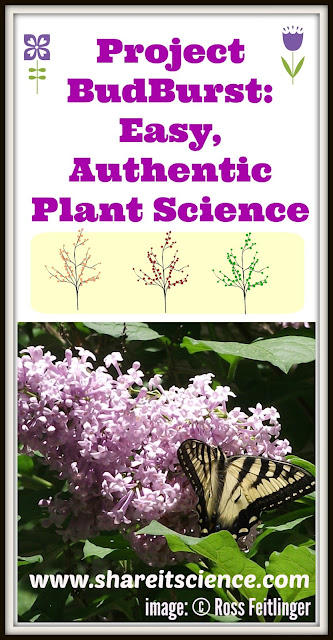
    Project BudBurst: Easy, Authentic Plant Science

    Project BudBurst! Learn how to participate in this awesome citizen science project with kids. It's fun, easy, gets kids outside and builds observation skills!

    Project BudBurst is a citizen science project that collects and interprets data about seasonal changes in plants. I have used their programs with my elementary students for several years with great success. People just like you and your students observe seasonal changes in plants- such as flower buds opening and leaves emerging, then share this information with scientists. Spring is here, so now is the time to get involved in this wonderful project!

    Read on to find out how incorporating this free project into your curriculum can be a valuable way to bolster student's ability and willingness to make careful observations, develop student's sense of place, and give opportunities for authentic science learning.

    Several years ago I began using the BudBurst Buddies program through Project Budburst with my second grade science students. Each spring we complete a unit on plants, so observing the plants on our campus and contributing actual science seemed like a natural fit. In BudBurst Buddies students choose a tree or a shrub that they observe of the course of the spring. Through kid-friendly data sheets they make observations and then we submit the data online. When they are finished they can print themselves a certificate. The kids absolutely love it, and I have noticed that it has increased their ability to observe something for an extended period of time, and notice things they normally would not. They build a relationship with their plant and continue to look at it closely when they see it out at recess or when they are walking to and from the parking lot. This is a program that I encourage students to try at home as well! 

    http://budburstbuddies.org/

    Project Budburst has much more to offer than just the BudBurst Buddies elementary program. The purpose of the project is to study the phenology of plants. Phenology is the study of specific biological events as the season and climate varies. Examples of this are plants growing leaves or flowering, migration or reproduction. The data collected by citizens and contributed to BudBurst can help scientists understand how non-living factors affect living organisms like plants as their environments change. By utilizing a large group of citizen volunteers, they can collect data to form an accurate picture of phenological changes on a local to national level.


    Forsythia ©SBF
    There are so many ways to use this program. I participate on an individual level by reporting the changes I see on plants in my yard, like forsythia and lilac. You do not have to have special skills or expertise in plant identification to participate. There are step-by-step instructions and lots of pictures to help you find the plants to observe. Once you've chosen a plant you can submit your data easily as a single report, which is a one-time event observation, or a regular report, where you'll observe plants over several seasons. You can search through your own data, see the other locations where people have made similar observations and look back through historical data. 

    In the past few years this project has expanded to providing many educational resources to make the program more accessible to teachers and students. You can easily register an entire class to participate in the program. On the educators page you'll find links to lesson plans, professional development and other resources. Whether you teach elementary, middle or high school, informally or undergraduates there are resources there for you! In my experience in communicating with those who work for Project BudBurst via the internet or in person at an NSTA conference, I have found everyone with the project to be knowledgeable, friendly and passionate.
    http://citizenscienceacademy.org/

    If you are looking for inexpensive professional development or graduate study, I would highly recommend the Citizen Science Academy. Last year I took the "Project BudBurst for K-12 Educators" online course. The price was very reasonable and I gained insight into phenology and how to implement the program at school. I enjoyed collaborating with educators at different levels from different parts of the country. If this is something that you are interested in trying, you can still register for the spring session for the next few days! (Registration for spring closes April 10th, 2015, but there is a summer session too!)

    Whether you are an individual who enjoys observing nature, a teacher, a homeschool family or fall into another category, there is something in this great program for you! It is a great way not only to study plants, but also to increase student's observation skills, interpret data, heighten awareness and develop a sense of place. With this very snowy and cold winter I am interested in comparing this year's data to last year's data in the Northeast. Do you think there will be a noticeable difference? I'd love to hear how you will use Project BudBurst.

    (These are affiliate links, please see disclosures for more details)


    Project BudBurst has generously sponsored the first of what will be two April giveaways on Share it! Science News. 2 lucky readers will win a Project BudBurst tote bag and a set of informational plant trading cards. 3 additional winners will receive a set of informational plant trading cards. The giveaway will only run from April 7th, 2015- April 14th, 2015 so enter today! Simply follow the directions to enter in the Rafflecopter box below. 

    Project BudBurst Links:


    a Rafflecopter giveaway

    The Great Backyard Bird Count and other Winter Citizen Science Projects

    Great Backyard Bird Count Winter Citizen Science

    As I mentioned in "See it? Share it!" last week, this weekend is the Great Backyard Bird Count, or GBBC. The GBBC is an annual bird counting project run by the Cornell lab and the Audubon Society. Participants watch birds for 15 minutes and contribute their findings. This is just one of the many great citizen science projects that run nationally, internationally and locally throughout the year. Just because it's cold does not mean there aren't many outdoor (and indoor) projects to contribute to!    

    Citizen Science projects are science research projects that utilize the abilities of interested citizens in collecting or analyzing data. Scientific discovery often involves A LOT of data and without the help of the masses the process can be much slower. Citizen science projects come with the added bonus for the volunteer of learning about something new and contributing firsthand to scientific research. Many of these projects are things that can be done as a family or in the classroom.

    Citizen science is a growing movement that is quickly gaining momentum, in fact, as I write this the inaugural conference of the newly organized Citizen Science Association is happening in San Jose, CA. The programming for the 2 day conference ranges from sessions on the specifics of different projects to thinking about how to keep volunteers interested, to developing a framework for citizen science in education. Science affects everyone and this is a great way to engage students and adults in real scientific discovery!
    Titmouse braving the snow! ©Ross Feitlinger

    This time of year is ripe with birding citizen science. The winter season kicks off with one of the oldest citizen science projects, the National Audubon Society's Christmas Bird Count (CBC). This event is just as it sounds, on Christmas Day birders grab their coats and binoculars and count the birds. Data is collected and compiled. The GBBC follows in February. Throughout November-early April you can also participate in Project Feederwatch, another bird observation project through the Cornell Lab of Ornithology. (Be aware there is a fee to participate in this project. Currently $15 for Cornell members and $18 otherwise- you get access to all data and data entry, in addition to their annual publication and newsletters.)

    eBird is another birders haven, where you can record bird sightings throughout the year and view real-time maps to see where others have spotted similar species. In addition to these national projects there are many local projects to participate in, especially if you check with your local Audubon Society or nature center. For example, the February Bald Eagle Watch by the Rocky Mountain Bird Observatory in Colorado, or the New Hampshire Winter Backyard Bird Survey by NH Audubon which is held this upcoming weekend, or the second weekend of February each year.
    Weddell Seal (NOAA Photo Library)

    Maybe bird-watching is not your cup of tea? Fear not, there are many other projects for you.  IceWatch USA is a climate and weather project where participants monitor a waterway, like a lake or bay to record ice and snow observations. Contributions are e-mailed to Nature Abounds, the organization that runs this project. There are also many indoor or online citizen science projects. Students can count Weddell Seals in Antarctica in an activity by the University of Minnesota's Polar Geospatial Center.  Zooniverse develops citizen science websites for a wide variety of projects. This is where you can find Project PenguinWatch, which I posted about in detail last fall. Another initiative beyond counting penguins is the Milky Way Project where people identify infrared image data from the Spitzer Space Telescope. Cyclone Center helps NOAA analyze cyclone data, in Bat Detective participants classify recordings of bat calls. Plus many, many more.
    Image from the Spitzer Space Telescope (NASA)

    So what are you waiting for? Beat the winter blues by jumping on the citizen science bandwagon! Do you already participate in a citizen science project? Share it by commenting below!

    Post updated: 4/10/16

    Weather: Authentic Science- Not Just Small Talk!

         What do you remember from your science classes? Film strips? Textbooks? Science Fair Projects? Did I even have science classes before High School? Yup. That is what I thought. If you are like me, most likely your passion for science was inspired early on by experiences outside of school. Although it might not be the case everywhere, in general I believe we have found much more effective ways to engage students in science. It is so important to get kids involved in authentic science projects where they are able to make meaningful, real-world connections. I was inspired today by an article on Eureka! Lab,  a feature of Student Science News on societyforscience.org. Teachers at the Governor's STEM Academy at a Harrisonburg, Virginia High School purchased weather balloon kits from Stratostar.  They used these kits to inspire their students in a wide range of concepts including atmospheric science, chemistry and engineering.
    (source)
    The Stratostar high altitude weather balloon kit is customizable to allow to for data collection in many different ways from weather conditions, to monitoring atmospheric radiation or even changes to the speed of sound as it moves through the atmosphere. The kits are customizable to fit the needs of the program. This particular school project got the kids so jazzed up they were willing to come in on weekends and take on the planning and execution of their weather balloon launch themselves! The big caveat here is the price tag of the kits. Running upwards of $12,000 you'll most likely need a sponsor or a good grant-writer to help fund a project like this. However, once you've obtained a kit, you can reuse many of the components. Although this particular kit might be out of reach for many of us, it begs the question- How can we find ways to connect students to affordable and authentic science experiences? The possibilities are out there!
          Studying the weather is an excellent place to start. We experience the weather each day and it will impact students throughout their adult life. Whether it is an impending polar vortex or a super storm, weather is an accessible real-life concept. I have incorporated the NASA S'COOL program into my 5th grade weather curriculum for several years. This is a free program that allows students to learn about clouds and their impact on weather and climate, while contributing data to scientific research. S'COOL, or Student Cloud Observations On-Line, teaches educators and students how to observe and identify cloud types to provide "ground-truth" data for the CERES (Clouds and the Earth's Radiant Energy System) satellites. The CERES satellites are gathering data and cloud images from their orbit above the Earth's surface. This is only one side of the picture. Students collect and provide data from the ground, to corroborate what is seen from above, hence: ground truth. In combination you then see the whole picture. Students can learn a lot from clouds- including how to predict the weather from them. Once my class has collected data during a CERES satellite overpass they input it on-line and receive a report back. S'COOL requests students analyze these reports to see how their data matches (or doesn't match) the CERES data. It is a dynamic, authentic process. The coordinator of the project, Dr. Lin H. Chambers, is always helpful and at times has even sent the students messages about their data. Once we noted that it began to hail during an observation. Lin wrote back a simple "Be careful out there!" and the kids thought it was great. Knowing that they were sending their data to a scientist who then communicated back to them solidified that this was the real deal! 


          NASA S'COOL certainly isn't the only project out there to engage students in meteorology and atmospheric science. Digital weather stations can be great way to collect weather data and share it with others. Many schools have weather stations linked to Weather Underground so they can monitor, collect and share real-time data. Even something as simple as building a rain gauge can engage students outside of the classroom. We recently made one out of a transparent container with our Kindergartners and placed it by the walkway so they can see it as they leave school for the day. The kids are excited and inspired to check it each day, and it was virtually free to build. I repeat...the possibilities are out there!
          How do you involve your children or students in experiential science? Comment below!

    Read More


    Weather Resources


    Weather Wiz Kids- Activities and Info from Meteorologist Crystal Wicker


    Weather Activities- excellent Lesson Plans from howtosmile.org


    Penguin Watch and other ways YOU can be a Scientist

    Penguin Watch is a citizen science project that is using people power to help propel scientific research. Citizen science projects are a great way for scientists to cast a wider net and collect more information than they might be able to with their own resources. Almost as importantly, from my perspective, these projects allow kids, families, schools and individuals a chance to contribute to real-world science projects. We are all part of this world and we all deserve to question and understand it.

    The purpose of Penguin Watch is to identify penguins in the photographs being taken by 90 cameras set up by two study groups in Antarctica. The cameras are set up at locations identified as potential breeding grounds. Reviewing these photos for penguin activity is crucial to understanding what the population truly is and the activity of the birds at the breeding grounds. The project has amassed over 200,000 pictures, much more than a few researchers can realistically review. When you visit the Penguin Watch website you can learn how to identify several different species of penguins and their chicks. If you choose to participate, you can click penguins you identify and submit your results to the scientists. It is easy and fun; some of the pictures are empty landscapes, yet others have too many penguins to count, most are somewhere in between. Eventually the human generated data will help "train" computers to assist scientists in counting penguins too. This would be a fun activity to do with your kids or in the classroom.

    Penguin Watch is part of the Citizen Scientist Alliance's Zooniverse. The Zooniverse is a collection of citizen science projects on the internet ranging from Astronomy to Oceanography. There are projects here for any interest. Many feel like you are solving a puzzle, you identify, measure, decipher and just click to send it to a researcher. Much like a game of computer solitaire it gives your brain a break by working on something different -yet relevant- which is arguably more useful than beating solitaire...and just as addictive!

    Citizen science projects are certainly not limited to those that are completed on a computer. Many involve getting outdoors. Cornell has several citizen science projects ranging from counting birds at feeders to observing bird nests to mapping out your yard for potential habitat. Projects Feederwatch, Nestwatch and Yardmap are just a few of the projects that can be found on the Cornell Citizen Science Blog. 

    If you enjoy trees and other plants, then Project BudBurst may be your cup of tea. Project BudBurst collects life cycle data on a variety of flowering plants to better understand our changing climate. Project BudBurst can be completed by adults or children. They offer a project geared towards children called "BudBurst Buddies". Project BudBurst also offers excellent professional development courses for teachers through the National Ecological Observatory Network (NEON) at very reasonable rates. I have implemented use of this program with students as young at second grade with great success.

    Another project introduced to me by a family that participated in it on their summer vacation is the Lost Lady Bug Project which teaches how to find, collect and photograph ladybugs to better observe shrinking native populations and growing introduced populations of ladybugs.

    If computer games are more your thing you can try Eyewire, or Fold-it. These evolved from some of the first computer network citizen science projects like SETI@home (Search for Extraterrestrial Intelligence) and Rosetta@home which both used the computing power of idle computers in homes and dorm rooms during the late 1990's and early 2000's. Eyewire is a game that is helping to map the brain by training people to identify and map neurons. Fold-it allows players to puzzle their way through the many possibilities of folding proteins and is making way for important research in medicine.

    Citizen science can be a fun and rewarding way to spend time on your own or with children to truly get involved in science. There are so many options out there for projects, they are definitely worth a look!

    Read more:
    Citizen Science Projects to Try!