We love visiting zoos, nature centers and aquariums as a family. Years ago I wrote about our trip to the Shedd Aquarium in Chicago, which was amazing. Recently we were lucky enough to visit the New England Aquarium in Boston, and we had a blast!
It had been a few years since we had visited and we were excited to see some of our old favorites. I could write pages about our day, but instead will highlight 10 reasons why you should visit the New England Aquarium if you have the chance.
African Penguin Colony
1. Penguins! One of the first animals you encounter upon entering the New England Aquarium are the endearing African Penguins. A bustling, and sometimes boisterous, group inhabits this enclosure that surrounds the Giant Ocean Tank, the four-story centerpiece to the aquarium. Hailing from temperate habitats, you won't see ice and snow here, but you will see a lot of interesting penguin behavior in the water and on the rocks.
Photo credit: Vanessa Kahn, New England Aquarium
My kids love to learn about each of these penguins. It is easy to do as each is tagged with colorful armbands that serve as identification. Interactive screens located around the African penguin exhibit allow visitors to plug in the colors and location of the tags. Each penguin has a "bio" explaining its name, age, sex, and other interesting facts.
Giant Ocean Tank
2. The Giant Ocean Tank is the amazing four-story centerpiece of the New England Aquarium. This enormous 200,000 gallon Caribbean reef tank holds hundreds of different fish. My kids loved seeing the giant rays taking their laps and discovering the different types of animals they could spot as we spiraled up towards the top of the tank.
The aquarium educators at the top of the tank are available to answer questions and its fun to watch the feeding divers too.
Photo credit: Vanessa Kahn, New England Aquarium
Myrtle the Turtle
3. An enormous green sea turtle! In 1970 a green sea turtle named Myrtle came to live at the New England Aquarium. You can still see her there today! It is such a treat to spot this gigantic turtle swimming around the Giant Ocean Tank or coming up to the top of the tank for some lettuce. She is a beautiful and amazing creature, somewhere between 70-90 years old and weighing in at over 500 pounds.
Photo credit: Vanessa Kahn, New England Aquarium
Sea Jellies
4. Sea Jellies! Even in a crowded aquarium, watching the Lion's mane jellies is a mesmerizing and calming experience. Native to colder regions of the ocean such as the Arctic and North Pacific, these jellies have a thick "mane" of hair-like tentacles to sting and catch prey such as small fish and crustaceans.
Giant Pacific Octopus
5. A visit to the New England Aquarium gives you the opportunity to see the largest species of octopus on the planet, the giant Pacific octopus. These super intelligent creatures can grow to be 20 feet long. We were lucky to see it put on a bit of a show right near the glass, as they can be a bit elusive. Stunning!
Photo credit: Vanessa Kahn, New England Aquarium
Sea Lion Show
6. What a treat to watch the California sea lions show off their skills and learn about sea lion handling and training at the show in the Marine Mammal Center. Not only endearing, intelligent, and entertaining, they are also talented in nature, able to swim faster than any other type of sea lion and dive underwater for up to ten minutes while they search for food. The whole family shared many smiles and laughs during this part of our aquarium visit.
Please note if you do visit the New England Aquarium that the Marine Mammal Center is an open air exhibit area. It's open year round and if you come during colder months (like we did this time) you'll want to bundle up!
Greeted by Harbor Seals
7. Before you even enter the aquarium you can observe the Atlantic harbor seal exhibit for free. The harbor seals are located in their enclosure in the front plaza. Get up close and personal with these playful creatures and even learn about them during feedings and training sessions before you even enter the aquarium.
Photo credit: Vanessa Kahn, New England Aquarium
We enjoyed watching them swim and play in the morning when we arrived, and got a chuckle at them apparently asleep floating in an upright position when we left later in the afternoon.
Shark and Ray Touch Tank
8. Unfortunately during our visit the Shark and Ray Touch Tank was closed. However, we did stop in the exhibit area to learn about sharks from an aquarium educator. I know if the touch tank had been open that day we would have really enjoyed it, it is a great space and one of few opportunities, unless you purchase a special Animal Encounter, to touch the ocean animals.
Photo credit: Vanessa Kahn, New England Aquarium
Aquarium Timed Admission
9. The timed admission system at the New England Aquarium was great for planning. We could see how many people had purchased tickets during each of the 20 minute intervals the aquarium was open. We were able to plan exactly when we wanted to go in the night before. Admission was smooth and we entered the aquarium quickly without waiting in line.
Parking in Boston can be tricky, however, there are several parking garages in close proximity to the aquarium. Several of them participate in parking validation at the visitor's desk in the aquarium. We used SpotHero and would highly recommend it. You can reserve a spot in a garage ahead of time, in some cases at a discounted rate, no searching for parking once you arrive!
Location, Location, Location: Central Wharf
10. The New England Aquarium is located on Central Wharf, right on Boston Harbor. A great locale for a summer stroll on a part of Boston's Harborwalk, good eats, duck tours, lots of history, and close proximity to other great museums such at the Boston Children's Museum and the Boston Museum of Science. A great area to visit for a lot of learning and family fun.
Kids love animals and have an innate desire want to categorize and sort things into groups. Why not combine these passions to build early observation skills in science? I was fortunate to be given the opportunity to review this year's Compare and Contrast books from Arbordale Publishing. I'd love to share this engaging book series with you along with resources and activity ideas for science class.
In this post you will find information about Compare and Contrast books, written by seasoned zoo and aquarium educators, as well as links to an infographic activity and how to use graphic organizers to build science skills in observation and categorization.
This post contains affiliate links, meaning I receive a commission
from purchases made through links, at no additional cost to you.
Please see
disclosures for more information.
Animal Compare and Contrast Books
The newest compare and contrast books from Arbordale Publishing feature dazzling photos of animals. In many cases the pictures give a glimpse of something we would not have an opportunity to see otherwise. We especially loved the images of turtles in Turtles: A Compare and Contrast Book. You can preview the turtle book here. (Recommended for ages 4-9, grades K-3)
Each book in the series is well organized. For example, Birds: A Compare and Contrast Book is organized by feature and adaptation. I think this makes this series perfect for the classroom or at home because students can find interesting information in a way that is logical and scaffolds off of their prior knowledge. You can preview the bird book here. (Recommended for ages 4-9, grades K-3)
While the turtle and bird books focus on one group of animals, others compare and contrast two similar yet different types of animal. These are wonderful for finding out why we may confuse two types of creatures and what actually makes them different from one another. These titles include: Alligator or Crocodile?, Black Bear or Grizzly Bear?, Hippo or Rhino? and Octopus or Squid?.
We definitely learned some interesting things we didn't know before from this book series.
Did you know?
There are 16 subspecies of Black Bear in North America. All subtle differences in DNA.
In addition to eight arms, squid have two tentacles covered in suction cups and hooks.
Black rhinos can grab onto things with their prehensile upper lip.
And many, many more interesting facts, but I don't want to spoil them all!
I loved that each book contained additional learning material, activities and ideas in the back. You could read the book just for fun, or turn it into a deeper learning experience with these extensions.
I believe the Compare and Contrast series would be an excellent addition to any classroom or home library. Engaging images, interesting and understandable content on topics kids get excited about.
Comparing and Contrasting for Preschool
Little ones love to sort! After a Compare and Contrast book read-aloud, get out a big sheet of paper (we love big paper rolls!) tape it to the floor and draw some sorting circles. Grab some animal toys (our Octonauts made it into the mix!) and have the kids sort based on color, type or however they choose.
This is excellent practice in making observations, looking carefully, comparing and contrasting.
Create an Infographic with Elementary Students
Use the Compare and Contrast series to have students design their own infographics. Using this template, kids can illustrate and write about an animal they have read about. Bits of information comparing their animal to another are explained with text and information. Once everyone is done the students can become the teachers and share their illustrated information with their peers.
T-charts are an easy way for young students to organize information when comparing two things. Circle the kids up and get out the chart paper to have them help you populate information into two categories.
Each spring for the past 4 years we have seen a little bit of magic happen on our kitchen counter. Tiny caterpillars arrive in the mail and over the next week or so grow so quickly you can almost see it happening. One day they find a cozy place to hang and you blink and they are no longer caterpillars, but tiny chrysalides. The rest of the action takes place inside, and we wish we had x-ray vision to let us see. One day, out come butterflies!
Raising butterflies from an Insect Lore cup of caterpillars is a very easy and fairly fool-proof way to share this magical life cycle with kids at home or school. Read on to find out how simple the process is and my recommendation for purchasing what you need.
Please note, this blog post was not written in partnership with Insect Lore. My opinions about their products come from my experience with them and I was not compensated to review their products. This post contains affiliate and referral links, meaning I receive a small
commission or points from purchases made through these links at no additional cost to you. Please see
disclosures for more information.
Butterfly Kits
Raising caterpillars into butterflies is a very easy and foolproof process with Insect Lore'sButterfly Garden kit. We purchased our first kit from Amazon to save a few dollars, but have continued to buy our Painted Lady caterpillars each year directly from Insect Lore. If you want to purchase your butterfly habitat with live caterpillars rather than a voucher to get the caterpillars at a later date, you should buy directly from Insect Lore. I recommend signing up for their newsletter as well and you will find many opportunities for sales like BOGO cup of caterpillars, kits and bonus gifts. (Plus their newsletter is fascinating, it's one of the few company e-mails I receive that I actually read all the way through!)
Our caterpillars always come quickly and in good health. The only issue I've had is that once there were only 4 caterpillars in our cup instead of 5. Customer service was very responsive and easy to work with. Our problem was resolved very quickly. I have always been so happy with this company.
Be sure that when you order your caterpillars it is the right time of year and temperature in your region to release them safely and for their health. Your caterpillars will arrive promptly after ordering them and you don't want it to be too cold or too hot for them to be traveling in the mail. You might also want to investigate whether or not you have a natural food source available for Painted Lady Butterflies. Flowers in the mallow and thistle families are good choices. You can learn more about the habitat requirements of Painted Lady Butterflies here.
Observing Butterfly Metamorphosis
The caterpillars come in a cup that holds all of the food they will need to grow over the next 2-4 weeks. You can leave them enclosed in the cup until they have each made a chrysalis. My one caveat with this is that it doesn't really show children how a caterpillar feeds in the wild. Munching away at some brown gel in the bottom of a cup isn't like munching at a plant. However, since we have young kids this is a really easy way to raise the caterpillars, and it proves very successful. We've only lost 2 butterflies from the 30 or so we have raised. The caterpillars are fascinating to watch and they grow SO, SO QUICKLY. It is mind boggling. It really is kind of like The Very Hungry Caterpillar.
Raising the caterpillars in a cup is a great teachable moment to investigate native plants and host plants for insects. You can work on answering the questions: How is this different than the Painted Lady Butterfly's life cycle in nature? What is a host plant? What part of the plant does a caterpillar depend on? What part of the plant does an adult butterfly depend on?
One day the bigger caterpillars begin to hang from the top of the cup in a "j" shape, and that is when you know that they are getting ready to pupate. Soon after there are chrysalides hanging from the lid of the cup where the caterpillars once were.
Then it is time to move the critters to their butterfly habitat while they make their incredible transformation. We are "Waiting for Wings"!
One day, those butterflies will emerge from their chrysalides. We have only actually witnessed it a few times, it happens very quickly. We feed our adult butterflies sugar water from a sponge, orange slices, and watermelon. The butterflies love watermelon! It is so cool to see that curly proboscis unfurl and slurp up the sugary liquid. This is a great time to make some observations that would be difficult to observe in the wild.
After a few days we release our Painted Ladies. It's always a bit of a bittersweet moment as we really enjoy having them, but it is also exciting to see them fly away and be free!
Take an Insect Class!
If your kids are wild about insects like mine, maybe they would enjoy my "Invent an Insect!" online class on Outschool. Learn the parts of an insect through games, songs and more in a lesson that I've had success teaching for almost 2 decades! Check out the schedule here. If you are new to Outschool, use my referral coupon code: MSSARAH2020 to receive $20 credit towards your first Outschool classes. You can find other coupon codes here.
If you have ever taught a lesson on the characteristics of reptiles then you have probably found that young elementary students often struggle with the idea of warm-blooded and cold-blooded animals. The term "cold-blooded" is misleading, cold-blooded animals are not always cold!
This science activity will help you model the concept of being ectothermic, or cold-blooded, by using temperature sensitive color changing play dough! It will help your science students or your kids at home better understand what happens when a turtle, snake or lizard sits in the sun or under a heat lamp. If you are looking to include STEM or STEAM elements in your curriculum, this activity includes art and design, as well as opportunities for including technology.
This post contains affiliate links, meaning I will receive a small commission (at no additional cost to you) if you make a purchase after clicking a product link. Please see disclosures for more information.
Cold-blooded vs. Warm-blooded
Students often believe that warm-blooded animals are always warm inside and cold-blooded animals are always cold inside. Warm-blooded animals, like mammals and birds, can regulate their own body temperature and maintain a consistent body temperature unless ill. Cold-blooded animals, like reptiles, amphibians and fish have a body temperature that adapts to the ambient temperature. If conditions are cold, the animal will be cold, and likewise if conditions are warm the animal will be warm.
Ectotherm (cold-blooded) and Endotherm (warm-blooded) are more accurate terms, but also can be confusing words for young students. The activity below will help model why cold-blooded animals must move locations to adjust their body temperature.
Cold-blooded Creatures Experiment
For this science lesson you will need the following:
To make our temperature sensitive color changing play dough, I used the recipe found in the STEAM Kids e-book (the print version available on Amazon). The secret sauce to temperature sensitive dough is thermochromic pigment. This pigment powder is the same stuff that causes mood rings to change color and makes the magic happen in other color-change products like nail polish.
If you are using the recipe from the STEAM Kids book (which I highly recommend for tons of little projects as well as ideas like this one that can be incorporated into other lessons) you will want to double, or maybe even triple the recipe when working with a large group of children.
When the dough is heated, it will change color. In this experiment, the color change is the indication that the "body temperature" of the dough creature is changing.
Experiment with Color Changing Cold-blooded Creatures!
Have students make a hypothesis about the outcome of shining the light on the dough animals. Will they heat up? How long will it take for the animal to change color?
Determine how you will run the experiment. How often will you check on the play dough animals? Will you be taking their surface temperature? How will you collect data?
Once the kids have designed and built their their reptiles, amphibians or fish, place them in the terrarium. Be sure everyone is on the same page on how the experiment will be run.
Clip the light to the side of the aquarium. Be sure everyone involved understands this lamp will get hot! Use the necessary precautions and adult supervision.
We found that in our experimental set-up the color change occurred very quickly when heated, then changed back very slowly when cooled. We decided to make a time-lapse video of the process to capture the changes. This brief video is comprised of many still photos of the changes that took place over several minutes.
Once the students have observed and collected data, wrap up with a discussion. Here are some potential discussion questions:
What was realistic about this model?
What was unrealistic?
How hot did the surface of the cold-blooded creatures in the experiment get?
Why do cold-blooded animals sun themselves?
How do cold-blooded animals survive the winter months in climates with freezing temperatures?
Kids love sharks! In this post you will find a book recommendation for a hilarious, yet factual, children's book about sharks, and an active science modeling activity for exploring the lives of sharks and the movement of food energy through an ecosystem.
Both the kid's book and science activity are great for your upper elementary school-aged kids at home or the students in your classroom. The modeling activity will get kids moving while building understanding of trophic pyramids and food chains.
If you are a teacher aligning your lesson plans with the Next Generation Science Standards, you will also find links for standards that this activity will help you meet.
This post contains affiliate links, meaning I will receive a small commission (at no additional cost to you) if you make a purchase after clicking a product link. Please see disclosures page for more information.
How to Survive as a Shark
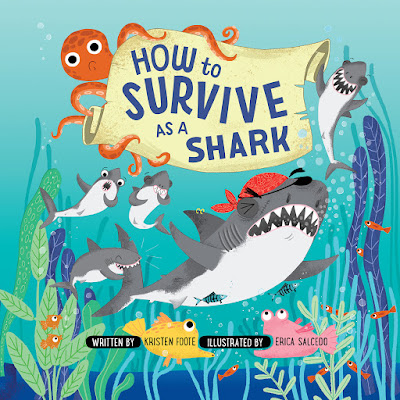
First of all, a read-aloud of Kristen Foote's How to Survive as a Shark is a must. This funny children's book, illustrated by Erica Salcedo, includes science facts about the life of sharks, white sharks in particular, their important place in the ecosystem, adaptations and more.
This book is perfect for upper elementary students. They enjoy the humor and understand the science. Even the kids who think they are too old for picture books get a kick of this one! The end of the story includes some discussion on what was realistic and what was fictionalized for the sake of presenting the information in the style of a humorous picture book. It is an all around great book for home or the classroom!
If you are reading How to Survive as a Shark as an intro to the activity outlined below, the strongest tie-in to the food chain and energy transfer is the discussion and illustration of the food pyramid (or trophic pyramid). In this story, white sharks are the apex predator. Depending on the species of shark, sharks may not always at the tippy top of their food chain. The food pyramid, discussion of the different levels of consumer and apex predators is a great introduction to the energy transfer activity below.
Shark Energy Activity
There are many food chains and food webs in any ecosystem, including the ocean. Energy moves through these ecosystems in the form of food. The active food chain activity outlined below allows students to model the transfer of food energy throughout a system and see it move first hand.
Split the group of kids into thirds. One group will be the "sharks", one group will be "large fish", and the last will be "small fish". [Note: if you are studying a specific type of shark, adapt the game to be specific to that species, i.e. "large fish" might be "tuna" or "seals" instead.]
Assign each of the groups a different color. This will be the color of the bandana that they will tie around their arm to denote their role in the activity.
Give each student a paper bag or envelope, which represents their stomach.
After assigning some boundaries for the play area, spread out the colored paper squares evenly throughout the area. These represent "plankton" in the activity.
Game play:
The goal of the small fish is to collect as much plankton as possible and put it in their stomachs.
The goal of the large fish is to eat the small fish, by gently tagging them, and transferring all of the plankton paper squares from the stomach/bag of the small fish to their own.
Similarly, the sharks will eat the large fish by gently tagging them, and transferring all of the plankton paper squares from the bag of the large fish to their own. (In reality, sharks may also eat small fish, but for simplicity's sake they will not in this simulation.)
Give just a few minutes (no more than 5) for game play. In order to have survived the round, small fish must have 5 plankton in their stomachs, large fish must have 10 plankton in their stomachs, and sharks must have "eaten" at least one large fish with 10 plankton in its stomach.
Write down how many of each animal survived after each round for graphing and data collection extensions.
Wrap it up:
Be sure to discuss the results of the modeling activity.
Guide your discussions with questions such as:
What trends do kids notice?
How is this activity realistic or unrealistic?
Create a data table or graph the results. Introduce the idea of a trophic, or ecological, pyramid and show how the amount of energy changes as it moves through the ecosystem.
Extend the Energy Transfer Activity
To continue modeling important ideas around energy transfer and balanced ecosystems, see what happens when you change the rules of the game. Try these adaptations of the simulation and discuss the results with your kids or students:
Change the number of sharks / small fish / large fish
Set out more "plankton"
Release the small fish first, then the large fish, and eventually the sharks
Set up a "safety zone" for fish
Align with the Next Generation Science Standards
This activity fits with the following 5th grade science standards:
I love Pass the Energy, Please! because of it's rhyming text and beautiful illustrations. Although it is a rhyming picture book, the vocabulary used is at an upper elementary level. The World of Food Chains with Max Axiom: Super Scientist appeals to upper elementary readers because it is written and illustrated in a graphic novel style.
Ocean Learning Activities
If your kids love learning about the ocean, then you won't want to miss these other fun ocean-themed science activities!
You may not be aware of this, but when you purchase a book published by The Innovation Press, like How to Survive as a Shark or How to Survive as a Firefly, you are not only getting a great book for the children in your life, but also helping others. For every 10 books sold, The Innovation Press donates one book to First Book, getting books into the hands of kids and schools in need.
What is not to love about fall? Crispy colored leaves on the ground, acorns, caterpillars, apples, pleasant weather...I could go on and on! It's the perfect time to get your children or students learning in nature.
Nature is a powerful teaching tool. It inspires kids to ask new questions, explore things they have not seen before and spending time outside has been shown to benefit kids overall health and learning. I've pulled together a bunch of resources to help you teach your students outside this fall. From pumpkins and apples to leaves and twigs, scavenger hunts to garden harvests, you'll find all the ideas you need to provide a nature-rich learning experience for your classroom or homeschool.
This post contains affiliate links, meaning I make a small commission (at no additional cost to you) from purchases made from these links. Please see disclosures for more information.
Observe Nature on a Scavenger Hunt
Get outside and put those powers of observation to good use. So many changes come with the turn of the season, there is a lot to see out there! Try one of these ideas:
Take advantage of those fall colors and the abundance of leaves that have dropped to the ground to create some great nature art. In choosing natural supplies for art pieces, students really take a closer look at these items than they might otherwise.
One of our favorite family activities is visiting aquariums, zoos and museums. As a teacher, I'm also always looking for great educational resources from these institutions. A recent visit to the Shedd Aquarium in Chicago, provided an excellent in-person experience and plenty of online resources and virtual experiences to share with you.
Although difficult to narrow it down to just a few, I've created this list of 10 reasons why you absolutely must either visit the Shedd Aquarium in person or online.These will be especially interesting for those of you who teach about aquatic life, or simply love to learn about and experience it.
This post contains affiliate links, please see disclosures for more information.
Top Ten Reasons to Visit the Shedd Aquarium
1. Bamboo Shark Eggs!
This is a great example of the "little things in life" being some of the most interesting and impressive. Despite all of the other fantastic creatures and exhibits we observed at the Shedd Aquarium, one of my favorites of everything we saw were the bamboo shark eggs on display in the Wild Reef exhibit.
Bamboo sharks are small sharks that are found in shallow, tropical reefs. We were able to view the sharks in their tank right next to the examples of their eggs. You could actually see the baby sharks moving around in their eggs!
We learned that it takes around 4 months for the bamboo sharks to hatch, but the exact timing is due to temperature. The babies are able to survive on their own once they have hatched.
Check out this short video clip from our visit. Keep an eye on the middle one, as that is the easiest to see move. They are even cooler in real life!
Wild Reef models the coral reefs of the Philippines. It is one of the main exhibits in the aquarium. We really appreciated the fact that the exhibit not only housed the wildlife of the reef, but also described the culture as well. I think it is rare that an aquarium describes in such detail how the aquatic environment impacts the culture and economy of an area, and vice-versa.
It was also fascinating to see how the aquarium was cultivating coral for the exhibit, which exclusively features coral grown right at the Shedd Aquarium.
The reefs of the Phillipines are some of the most diverse coral reefs in the world. We saw some of our favorite colorful creatures here.
We found Dory! Can you find her too?
2. See dolphins up close!
We attended a live animal show that included observing the aquarium's Pacific white-sided dolphins. The dolphin tank and the aquatic shows are part of the Abbott Oceanarium, a fabulous space modeled after the Pacific Northwest coast.
After the show, the area cleared out and we had a few minutes where we could watch the dolphins swim, jump and dive without a huge crowd around. It was much more exciting than simply watching them behind glass. It was also interesting during the show to see firsthand how the dolphins are trained.
3. Fabulous Exhibits
The Shedd is absolutely a world class aquarium. The exhibit spaces were detailed, with excellent signage and understandable, accessible interpretation.
In addition to the Wild Reef and Abbott Oceanarium I mentioned above, there are several other large exhibits that make up the aquarium.
Amazon Rising takes you along the Amazon river during the rainy season when the forests are flooded. In addition to fish like piranhas, we spotted tiny Goeldi's monkeys, an anaconda (or the skin it last shed anyway, most of the large snake was hidden underwater) tarantulas and stingrays.
In addition to galleries on the life of the ocean, in lakes, in rivers and the local fauna of the Great Lakes, the Caribbean Reef is a must-see. It is also hard to miss it as this 90,000 gallon tank is the centerpiece of the main exhibit space of the aquarium.
4. Knowledgeable, Friendly Staff and World Class Research
I was so impressed with everyone we met at the aquarium. All had a smile on their face, a friendly greeting and were very knowledgeable. It was really a nice change of pace to visit a place where it truly seemed like everyone was happy and interested to be there!
The Shedd is a leader in conservation and aquatic research. From field work on the Great Lakes and in the Caribbean, and on-site research and breeding programs, the Shedd Aquarium works alongside and to inform the greater scientific community. Check out this link for a great launching point into the great work they do.
5. Virtual Field Trips
Maybe you can't actually visit the Shedd Aquarium, but you'd like your classroom or homeschool students to experience the aquarium. You're in luck because they offer virtual field trips for reasonable rates. Learn more here.
6. Accessibility
The entire Shedd Aquarium is accessible so no one has to miss out. We found this very helpful as we visited with a young child in a stroller, which many others were doing as well. Although I was thrilled about the ability to travel anywhere with the stroller, I'd advise you give yourself a little extra time to get from place to place if you need to use the elevators. When the aquarium is busy there is often a short wait for them.
The Shedd also offers a Sensory Friendly App, with visitors with autism or sensory processing disorder in mind. Learn more about this app and accessibility at the Shedd Aquarium here.
7. Penguins!
Need I say more? Who doesn't like watching penguins?! It was our daughter's favorite spot.
The facade of the beautiful Shedd Aquarium building has been named a National Historic Landmark by the National Parks Service. The building is just one part of Chicago's Museum campus, which is 57 acres along Lake Michigan and includes the Adler Planetarium, the Field Museum of Natural History, and Soldier Field. We enjoyed walking through the lovely park campus during our visit.
9. Classroom Clubs and Competitions
In addition to their regular education programs, school visits and the like, Shedd also offers cool opportunities like the NextGen Animal Responders program, a curriculum guide that brings animal rescue efforts to life, and the Underwater Robotics Club, several different STEM programs and resources for teachers that allow kids to delve into the engineering and design of underwater ROVs (remotely operated vehicles).
10. Citizen Science
If you're a regular reader of this blog, then you know how much we like citizen science! The Shedd Aquarium supports several citizen science projects, including working to save seahorses through iSeahorse, a project that anyone can participate in.
We really enjoyed our visit to the Shedd Aquarium and hope we get back to visit again one day! I hope that you get a chance to visit in person or online soon!