Share it! Science : ocean
Showing posts with label ocean. Show all posts

10 Reasons to Visit the New England Aquarium

We love visiting zoos, nature centers and aquariums as a family. Years ago I wrote about our trip to the Shedd Aquarium in Chicago, which was amazing. Recently we were lucky enough to visit the New England Aquarium in Boston, and we had a blast! 
 
It had been a few years since we had visited and we were excited to see some of our old favorites. I could write pages about our day, but instead will highlight 10 reasons why you should visit the New England Aquarium if you have the chance.


African Penguin Colony

 
1. Penguins! One of the first animals you encounter upon entering the New England Aquarium are the endearing African Penguins. A bustling, and sometimes boisterous, group inhabits this enclosure that surrounds the Giant Ocean Tank, the four-story centerpiece to the aquarium. Hailing from temperate habitats, you won't see ice and snow here, but you will see a lot of interesting penguin behavior in the water and on the rocks. 

African Penguin New England Aquarium  Photo credit: Vanessa Kahn
Photo credit: Vanessa Kahn, New England Aquarium
 
My kids love to learn about each of these penguins. It is easy to do as each is tagged with colorful armbands that serve as identification. Interactive screens located around the African penguin exhibit allow visitors to plug in the colors and location of the tags. Each penguin has a "bio" explaining its name, age, sex, and other interesting facts. 

Giant Ocean Tank


2. The Giant Ocean Tank is the amazing four-story centerpiece of the New England Aquarium. This enormous 200,000 gallon Caribbean reef tank holds hundreds of different fish. My kids loved seeing the giant rays taking their laps and discovering the different types of animals they could spot as we spiraled up towards the top of the tank. 

The aquarium educators at the top of the tank are available to answer questions and its fun to watch the feeding divers too. 

Giant Ocean Tank New England Aquarium photo credit: Vanessa KahnPhoto credit: Vanessa Kahn, New England Aquarium

Myrtle the Turtle

 
3. An enormous green sea turtle! In 1970 a green sea turtle named Myrtle came to live at the New England Aquarium. You can still see her there today! It is such a treat to spot this gigantic turtle swimming around the Giant Ocean Tank or coming up to the top of the tank for some lettuce. She is a beautiful and amazing creature, somewhere between 70-90 years old and weighing in at over 500 pounds.
green sea turtle Photo credit: Vanessa Kahn, New England AquariumPhoto credit: Vanessa Kahn, New England Aquarium
 

Sea Jellies


4. Sea Jellies! Even in a crowded aquarium, watching the Lion's mane jellies is a mesmerizing and calming experience. Native to colder regions of the ocean such as the Arctic and North Pacific, these jellies have a thick "mane" of hair-like tentacles to sting and catch prey such as small fish and crustaceans.


Giant Pacific Octopus


5. A visit to the New England Aquarium gives you the opportunity to see the largest species of octopus on the planet, the giant Pacific octopus. These super intelligent creatures can grow to be 20 feet long. We were lucky to see it put on a bit of a show right near the glass, as they can be a bit elusive. Stunning! 


Giant Pacific Octopus New England Aquarium photo credit: Vanessa Kahn
Photo credit: Vanessa Kahn, New England Aquarium

Sea Lion Show


6. What a treat to watch the California sea lions show off their skills and learn about sea lion handling and training at the show in the Marine Mammal Center.  Not only endearing, intelligent, and entertaining, they are also talented in nature, able to swim faster than any other type of sea lion and dive underwater for up to ten minutes while they search for food. The whole family shared many smiles and laughs during this part of our aquarium visit. 

Please note if you do visit the New England Aquarium that the Marine Mammal Center is an open air exhibit area. It's open year round and if you come during colder months (like we did this time) you'll want to bundle up! 

California sea lion training show New England Aquarium

Greeted by Harbor Seals


7. Before you even enter the aquarium you can observe the Atlantic harbor seal exhibit for free. The harbor seals are located in their enclosure in the front plaza. Get up close and personal with these playful creatures and even learn about them during feedings and training sessions before you even enter the aquarium. 

atlantic harbor seal new england aquarium photo credit: vanessa kahn
Photo credit: Vanessa Kahn, New England Aquarium

We enjoyed watching them swim and play in the morning when we arrived, and got a chuckle at them apparently asleep floating in an upright position when we left later in the afternoon. 

atlantic harbor seal free exhibit new england aquarium


Shark and Ray Touch Tank


8. Unfortunately during our visit the Shark and Ray Touch Tank was closed. However, we did stop in the exhibit area to learn about sharks from an aquarium educator. I know if the touch tank had been open that day we would have really enjoyed it, it is a great space and one of few opportunities, unless you purchase a special Animal Encounter, to touch the ocean animals. 

shark and ray touch tank new england aquarium photo credit: vanessa kahn
Photo credit: Vanessa Kahn, New England Aquarium

Aquarium Timed Admission


9. The timed admission system at the New England Aquarium was great for planning. We could see how many people had purchased tickets during each of the 20 minute intervals the aquarium was open. We were able to plan exactly when we wanted to go in the night before. Admission was smooth and we entered the aquarium quickly without waiting in line. 

Parking in Boston can be tricky, however, there are several parking garages in close proximity to the aquarium. Several of them participate in parking validation at the visitor's desk in the aquarium. We used SpotHero and would highly recommend it. You can reserve a spot in a garage ahead of time, in some cases at a discounted rate, no searching for parking once you arrive! 

Location, Location, Location: Central Wharf


10. The New England Aquarium is located on Central Wharf, right on Boston Harbor. A great locale for a summer stroll on a part of Boston's Harborwalk, good eats, duck tours, lots of history, and close proximity to other great museums such at the Boston Children's Museum and the Boston Museum of Science. A great area to visit for a lot of learning and family fun. 
 

Surviving Like a Shark Energy Transfer Game

Kids love sharks! In this post you will find a book recommendation for a hilarious, yet factual, children's book about sharks, and an active science modeling activity for exploring the lives of sharks and the movement of food energy through an ecosystem.

Both the kid's book and science activity are great for your upper elementary school-aged kids at home or the students in your classroom. The modeling activity will get kids moving while building understanding of trophic pyramids and food chains.

If you are a teacher aligning your lesson plans with the Next Generation Science Standards, you will also find links for standards that this activity will help you meet.

Shark Science Food Chain Energy Activity

This post contains affiliate links, meaning I will receive a small commission (at no additional cost to you) if you make a purchase after clicking a product link. Please see disclosures page for more information.

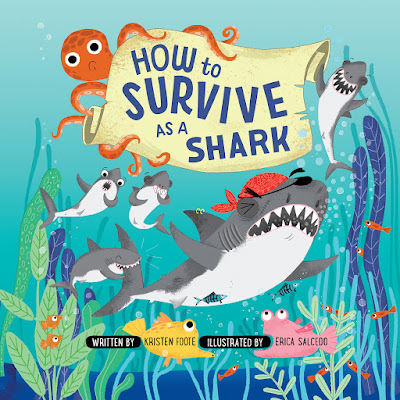
How to Survive as a Shark 


First of all, a read-aloud of Kristen Foote's How to Survive as a Shark is a must. This funny children's book, illustrated by Erica Salcedo, includes science facts about the life of sharks, white sharks in particular, their important place in the ecosystem, adaptations and more.

https://amzn.to/2LZaY6f


This book is perfect for upper elementary students. They enjoy the humor and understand the science. Even the kids who think they are too old for picture books get a kick of this one! The end of the story includes some discussion on what was realistic and what was fictionalized for the sake of presenting the information in the style of a humorous picture book. It is an all around great book for home or the classroom!

If you are reading How to Survive as a Shark as an intro to the activity outlined below, the strongest tie-in to the food chain and energy transfer is the discussion and illustration of the food pyramid (or trophic pyramid). In this story, white sharks are the apex predator. Depending on the species of shark, sharks may not always at the tippy top of their food chain. The food pyramid, discussion of the different levels of consumer and apex predators is a great introduction to the energy transfer activity below.


Shark Energy Activity


There are many food chains and food webs in any ecosystem, including the ocean. Energy moves through these ecosystems in the form of food. The active food chain activity outlined below allows students to model the transfer of food energy throughout a system and see it move first hand.

Shark Food Chain Science Activity NGSS aligned

For this activity you will need:


Model Energy Transfer in the Ocean


Set up the game: 

Split the group of kids into thirds. One group will be the "sharks", one group will be "large fish", and the last will be "small fish". [Note: if you are studying a specific type of shark, adapt the game to be specific to that species, i.e. "large fish" might be "tuna" or "seals" instead.]

Assign each of the groups a different color. This will be the color of the bandana that they will tie around their arm to denote their role in the activity.

Give each student a paper bag or envelope, which represents their stomach.

After assigning some boundaries for the play area, spread out the colored paper squares evenly throughout the area. These represent "plankton" in the activity.

How to Survive as a Shark illustrated by Erica Salcedo Science Activity

Game play: 

The goal of the small fish is to collect as much plankton as possible and put it in their stomachs.

The goal of the large fish is to eat the small fish, by gently tagging them, and transferring all of the plankton paper squares from the stomach/bag of the small fish to their own.

Similarly, the sharks will eat the large fish by gently tagging them, and transferring all of the plankton paper squares from the bag of the large fish to their own. (In reality, sharks may also eat small fish, but for simplicity's sake they will not in this simulation.)

Give just a few minutes (no more than 5) for game play. In order to have survived the round, small fish must have 5 plankton in their stomachs, large fish must have 10 plankton in their stomachs, and sharks must have "eaten" at least one large fish with 10 plankton in its stomach.

Write down how many of each animal survived after each round for graphing and data collection extensions.

How to Survive as a Shark illustrated by Erica Salcedo Science Activity

Wrap it up:

Be sure to discuss the results of the modeling activity.
Guide your discussions with questions such as:
  • What trends do kids notice? 
  • How is this activity realistic or unrealistic?

Create a data table or graph the results. Introduce the idea of a trophic, or ecological, pyramid and show how the amount of energy changes as it moves through the ecosystem.

Ecological Pyramid


Extend the Energy Transfer Activity


To continue modeling important ideas around energy transfer and balanced ecosystems, see what happens when you change the rules of the game. Try these adaptations of the simulation and discuss the results with your kids or students:

  • Change the number of sharks / small fish / large fish 
  • Set out more "plankton"
  • Release the small fish first, then the large fish, and eventually the sharks
  • Set up a "safety zone" for fish


Align with the Next Generation Science Standards


This activity fits with the following 5th grade science standards:

Additional Energy Transfer and Food Chain Book Recommendations 


Teaching about ecosystems is one of my favorite topics. If you are looking for other great books to share on the subject of energy transfer and food chains, you will definitely want to get your hands on a copy of Pass the Energy, Please! and The World of Food Chains with Max Axiom: Super Scientist.

I love Pass the Energy, Please! because of it's rhyming text and beautiful illustrations. Although it is a rhyming picture book, the vocabulary used is at an upper elementary level. The World of Food Chains with Max Axiom: Super Scientist appeals to upper elementary readers because it is written and illustrated in a graphic novel style.


Ocean Learning Activities


Ocean Science STEM Activities

If your kids love learning about the ocean, then you won't want to miss these other fun ocean-themed science activities!

Experiment with fizzing sea shells in this activity on the Teaching Without Chairs blog, and recreate the layers of the ocean with this density activity over on From Engineer to Stay at Home Mom.

More Shark STEM and Science


Shark Week Science and STEM activities

Can't get enough shark science? Same here. Check out these AMAZING shark eggs we saw at the Shedd Aquarium.

You'll find a bunch of shark STEM activities here, particularly fun for all of you "shark week" fans.

Want to know how sharks float? You'll find a cool hands-on shark experiment here. 

Go visit some real sharks at an aquarium! Find out why we love the New England Aquarium and the Shedd Aquarium.


Buy a Book and Help a Good Cause


You may not be aware of this, but when you purchase a book published by The Innovation Press, like How to Survive as a Shark or How to Survive as a Firefly, you are not only getting a great book for the children in your life, but also helping others. For every 10 books sold, The Innovation Press donates one book to First Book, getting books into the hands of kids and schools in need.


10 Reasons to Visit Chicago's Shedd Aquarium In Person or Online

One of our favorite family activities is visiting aquariums, zoos and museums. As a teacher, I'm also always looking for great educational resources from these institutions. A recent visit to the Shedd Aquarium in Chicago, provided an excellent in-person experience and plenty of online resources and virtual experiences to share with you.

Although difficult to narrow it down to just a few, I've created this list of 10 reasons why you absolutely must either visit the Shedd Aquarium in person or online.These will be especially interesting for those of you who teach about aquatic life, or simply love to learn about and experience it. 

Learn at the Shedd Aquarium, in person or online


This post contains affiliate links, please see disclosures for more information. 

Top Ten Reasons to Visit the Shedd Aquarium 


1. Bamboo Shark Eggs! 


This is a great example of the "little things in life" being some of the most interesting and impressive. Despite all of the other fantastic creatures and exhibits we observed at the Shedd Aquarium, one of my favorites of everything we saw were the bamboo shark eggs on display in the Wild Reef exhibit.

Learn at the Shedd Aquarium, in person or online

Bamboo sharks are small sharks that are found in shallow, tropical reefs. We were able to view the sharks in their tank right next to the examples of their eggs. You could actually see the baby sharks moving around in their eggs!

We learned that it takes around 4 months for the bamboo sharks to hatch, but the exact timing is due to temperature. The babies are able to survive on their own once they have hatched. 

Check out this short video clip from our visit. Keep an eye on the middle one, as that is the easiest to see move. They are even cooler in real life!


Wild Reef models the coral reefs of the Philippines. It is one of the main exhibits in the aquarium.  We really appreciated the fact that the exhibit not only housed the wildlife of the reef, but also described the culture as well. I think it is rare that an aquarium describes in such detail how the aquatic environment impacts the culture and economy of an area, and vice-versa.
Learn at the Shedd Aquarium, in person or online

It was also fascinating to see how the aquarium was cultivating coral for the exhibit, which exclusively features coral grown right at the Shedd Aquarium.
Learn at the Shedd Aquarium, in person or online

The reefs of the Phillipines are some of the most diverse coral reefs in the world. We saw some of our favorite colorful creatures here.

Learn at the Shedd Aquarium, in person or online
We found Dory! Can you find her too?

Learn at the Shedd Aquarium, in person or online

Learn at the Shedd Aquarium, in person or online

2. See dolphins up close!


We attended a live animal show that included observing the aquarium's Pacific white-sided dolphins. The dolphin tank and the aquatic shows are part of the Abbott Oceanarium, a fabulous space modeled after the Pacific Northwest coast.

Learn at the Shedd Aquarium, in person or online

After the show, the area cleared out and we had a few minutes where we could watch the dolphins swim, jump and dive without a huge crowd around. It was much more exciting than simply watching them behind glass. It was also interesting during the show to see firsthand how the dolphins are trained.

Learn at the Shedd Aquarium, in person or online


3. Fabulous Exhibits


The Shedd is absolutely a world class aquarium. The exhibit spaces were detailed, with excellent signage and understandable, accessible interpretation.

In addition to the Wild Reef and Abbott Oceanarium I mentioned above, there are several other large exhibits that make up the aquarium.

Amazon Rising takes you along the Amazon river during the rainy season when the forests are flooded. In addition to fish like piranhas, we spotted tiny Goeldi's monkeys, an anaconda (or the skin it last shed anyway, most of the large snake was hidden underwater) tarantulas and stingrays.

Learn at the Shedd Aquarium, in person or online

Learn at the Shedd Aquarium, in person or online

In addition to galleries on the life of the ocean, in lakes, in rivers and the local fauna of the Great Lakes, the Caribbean Reef is a must-see. It is also hard to miss it as this 90,000 gallon tank is the centerpiece of the main exhibit space of the aquarium.

Learn at the Shedd Aquarium, in person or online


4. Knowledgeable, Friendly Staff and World Class Research


I was so impressed with everyone we met at the aquarium. All had a smile on their face, a friendly greeting and were very knowledgeable. It was really a nice change of pace to visit a place where it truly seemed like everyone was happy and interested to be there!

The Shedd is a leader in conservation and aquatic research. From field work on the Great Lakes and in the Caribbean, and on-site research and breeding programs, the Shedd Aquarium works alongside and to inform the greater scientific community. Check out this link for a great launching point into the great work they do.

Learn at the Shedd Aquarium, in person or online

5. Virtual Field Trips


Maybe you can't actually visit the Shedd Aquarium, but you'd like your classroom or homeschool students to experience the aquarium. You're in luck because they offer virtual field trips for reasonable rates. Learn more here. 


6. Accessibility


The entire Shedd Aquarium is accessible so no one has to miss out. We found this very helpful as we visited with a young child in a stroller, which many others were doing as well. Although I was thrilled about the ability to travel anywhere with the stroller, I'd advise you give yourself a little extra time to get from place to place if you need to use the elevators. When the aquarium is busy there is often a short wait for them.

The Shedd also offers a Sensory Friendly App, with visitors with autism or sensory processing disorder in mind. Learn more about this app and accessibility at the Shedd Aquarium here.


7. Penguins!


Need I say more? Who doesn't like watching penguins?! It was our daughter's favorite spot.

We didn't experience the special Penguin Encounter program, but that looks fun too!

Learn at the Shedd Aquarium, in person or online


8. A National Historical Landmark

Learn at the Shedd Aquarium, in person or online

The facade of the beautiful Shedd Aquarium building has been named a National Historic Landmark by the National Parks Service. The building is just one part of Chicago's Museum campus, which is 57 acres along Lake Michigan and includes the Adler Planetarium, the Field Museum of Natural History, and Soldier Field. We enjoyed walking through the lovely park campus during our visit.

Learn at the Shedd Aquarium, in person or online

Learn at the Shedd Aquarium, in person or online

9. Classroom Clubs and Competitions


In addition to their regular education programs, school visits and the like, Shedd also offers cool opportunities like the NextGen Animal Responders program, a curriculum guide that brings animal rescue efforts to life, and the Underwater Robotics Club, several different STEM programs and resources for teachers that allow kids to delve into the engineering and design of underwater ROVs (remotely operated vehicles).

10. Citizen Science


If you're a regular reader of this blog, then you know how much we like citizen science! The Shedd Aquarium supports several citizen science projects, including working to save seahorses through iSeahorse, a project that anyone can participate in.

Learn at the Shedd Aquarium, in person or online

We really enjoyed our visit to the Shedd Aquarium and hope we get back to visit again one day! I hope that you get a chance to visit in person or online soon!

Beluga Whales Blow Bubbles!

Beluga Whales Blow Bubbles! www.shareitscience.com

"Baby Beluga in the Deep Blue Sea!" It is hard to get that old Raffi tune out of my head as I am writing this post. Beluga whales are fascinating and charismatic creatures. This recent research on them may be an interesting entry point to learning about this whale at school or home.

This post contains affiliate links. See disclosures for details.

Did you know that beluga whales blow bubbles from their blow holes? Not only do they blow bubbles, but they can control the types of bubbles they are blowing, and scientists now believe these different bubbles represent the mood of the animal!

It seemed odd for an animal that needs to hold its breath underwater to purposefully blow bubbles, so researchers were interested in getting to the bottom of the phenomenon. The research took place at Marineland of Canada in Niagara Falls, Ontario by a team of researchers from Canisius College. During the 8 year study they found that practically all the beluga whales blew bubbles in four source-shape combinations: blowhole drips, blowhole bursts, blowhole streams and mouth rings. The bubbles were produced by males and females, adults and juveniles. 

beluga whale vancouver aquarium learning resources whales
Beluga Whale at the Vancouver Aquarium
Stan Shebs [GFDL, CC BY-SA 3.0 or CC BY-SA 2.5], via Wikimedia Commons

"Blowhole bursts" are part of the beluga's startle response. These are produced most often by adult females, indicating that in nature they are more reactive than adult males. Juvenile males made this type of bubble more often than females and researchers believe that this is because they engage in rowdier levels of play than the females.

Although "blowhole streams" are a sign of aggression in humpback whales, the belugas exhibited this type of bubbling when they were swimming in a friendly manner side-by-side. The scientists found that some days the whales blew many bubbles and other days they did not. As the conditions of the aquarium were similar everyday, it seems very likely that the behavior is indicative of mood rather than environmental conditions.
size comparison of beluga whale and human learning resources whales
Beluga and Human Size Comparison
by Chris huh [GFDL or CC-BY-SA-3.0], via Wikimedia Commons

Imagine if we communicated with each other this way! There is a lot to learn about beluga whales. They are relatively small whales that live in shallow areas in arctic waters. It is the only species of whale that is known to be entirely white as an adult.

If you live in New England, you are not far from the largest outdoor beluga exhibit in the United States, at the Mystic Aquarium in CT. It would be difficult not to become instantly smitten with these friendly whales that come to see you as you approach their enclosure.

If you are unable to travel to an aquarium, check out the beluga cam from the Vancouver Aquarium!  You might also want to check these books out for purchase or at the library: Beluga Whales: Animals of the Snow and Ice, Hello, Baby Beluga! (for early readers), and if you just can't get the song out of your head, like I can't, Baby Beluga, Raffi Songs to Read.


Learning Resources for Beluga Whales:

The World's Water Situation: A Science Demo for School or Home


Have you ever tried to reason with a kid about why they shouldn't waste water? "Why? It just keeps coming out of the faucet!" Just telling them not to waste it is probably about as effective as our parents telling us to eat our vegetables because there were starving kids in far off places. "So what? They won't get this food whether I eat it or not!"

Kids (and adults!) in developed parts of the world often take water for granted. We are lucky, unless we are experiencing a drought, to have a fairly consistent, clean water supply. This is certainly not the case everywhere.
by Scott Robinson
Let's look at 2 current events in the world's water situation. We've got some good news and some bad news. Then we'll explore a really effective hands-on way to educate about water conservation.

This post contains affiliate links, please see disclosures for more details. 

So first, the bad news... Have you heard about the toxic foam that forms on Bellandur Lake in India? I hadn't until I was assigned a writing piece on it. A combination of industrial waste and raw sewage has created a dire situation in this lake in the highly populated city of Bangalore. For decades pollution has been dumped in a series of canals that ends in Bellandur Lake. The winds and rain from monsoon season just add to the problem and make the foam build up. The foam flies through the air and builds up on the roads slowing traffic much like a snowstorm. It is giving people headaches, smells awful and sticks to your skin. Last May it even caught on fire! Lack of government funds, policing and environmental regulations prevent the problem from getting any better. Sort of a foamy nightmare.


The good news...An incredible young innovator has devised a plan to help clean up the Great Pacific Garbage Patch. Boyan Slat, a young Dutch entrepreneur and inventor, has an ingenious and cost effective plan in action to clean up a large portion of the bits of plastic that are floating, and breaking down, in the ocean. This plastic is slowly making its way into the food chain and causing human health issues, not to mention the devastation to aquatic wildlife as the trash floats around in the water. Slat's plan uses natural circular currents in the ocean, called gyres, to passively collect the plastic. It is corralled and collected, then recycled into oil to offset the cost of the collection. Amazing. Read more about his project, The Ocean Cleanup, here in the kid's article I wrote for DOGOnews.


So, there are negative things happening to the world's water, and some positive efforts to make changes for the better. The lesson for our kids is that although Earth is covered in water, very little of it is available for us to use. That is why we need to conserve what we have.

An effective hands-on way to show this is to do this demonstration at school or home. You can have students or your children help measure out the water in each step. Through the years I have come across many variations of this lesson. Here are two versions that I have adapted. One version is for those of you with access to science lab containers, like graduated cylinders, and the other version uses things you can more readily find around the house.

 
Version 1: The World's Water Demo with Materials from the Science Lab


Supplies:
  • 1000 ml graduated cylinder
  • 100 ml graduated cylinder
  • 10 ml graduated cylinder
  • petri dish (or any dish)
  • eyedropper
  • water
1. Fill the 1000 ml graduated cylinder with water. This represents all of the water on Earth.

2. Now pour 30 ml of this water into the 100 ml graduated cylinder. This represents Earth's fresh water. The remaining 970 ml represents the salt water in the ocean. We can't drink salt water!

4. Carefully pour about 6 ml of the "fresh" water into the petri dish. This represents the fresh water that is not frozen in ice caps or glaciers.

5. Of the water in the dish less than 1/3 represents water that is available above ground. Take an eye dropper and remove 1 drop of water from the dish. This represents the water that is clean, fresh, not polluted and otherwise available to use.


Version 2: The World's Water Demo with Materials from Home

Supplies:
  • 1 gallon jug
  • 1/2 cup measuring cup
  • 1 Tablespoon
  • eyedropper (or a straw to make a drop)
  • water
1. Fill the jug with water. This represents all of the water on Earth.

2. Take 1/2 cup of this water and pour it into one of the clear cups. This represents Earth's fresh water. The rest of the water in the jug represents salt water. We can't drink salt water!

3. From the 1/2 cup of water in the clear cup, take 4 Tablespoons of water and pour this into the second clear cup. This represents the fresh water that is not frozen in ice caps or glaciers.

4. From the cup with the 4 Tablespoons of water, remove one drop with the eyedropper or straw and put it in the third clear cup. This represents the water that is clean, fresh, not polluted and otherwise available to use.


Pretty mind-blowing, huh? Well there is good news here and there is bad news. The bad news is, we don't have a ton of available fresh water on Earth, so we need to understand how precious it is. The good news is we can teach our kids to conserve it!

 
For other ways to teach water conservation and test water quality, read my post: Science Teacher's Toolbox: Testing Water Quality

http://www.shareitscience.com/2015/06/science-teachers-toolbox-testing-water.html

You might also want to check out Smarty Pants' TED-Ed video as a way to introduce water conservation!

Try these books to teach about water conservation!