Share it! Science : eclipse
Showing posts with label eclipse. Show all posts

Everything You Need to Know to Safely View Total Solar Eclipse 2024

On April 8th, 2024 there will be a total solar eclipse viewable across North America, passing through the United States from Texas to Maine. A partial eclipse will be visible across all 48 contiguous states. 

Will you be observing this awesome celestial event? Did you catch the "Great American Solar Eclipse" in 2017? These total eclipses have been such a fantastic opportunity to bring so many of us together to observe a scientific phenomenon. I love it when we all have something science-related to get excited about! 

Find out here what happens during a solar eclipse, when and where to observe the solar eclipse in April, and most importantly, how to observe it safely.  

How to Observe Total Solar Eclipse 2024 Safely

This post contains affiliate links, meaning I receive a small commission from purchases made through these links at no additional cost to you. Please see disclosures for more information.

What is a Solar Eclipse?

There are two types of eclipses, a lunar eclipse and a solar eclipse. A lunar eclipse occurs when the Earth passes between the Sun and Moon, blocking the Sun's light and casting a shadow on the Moon. You probably have observed at least one of these in your lifetime. 
 
A solar eclipse occurs when the Moon passes between the Earth and the Sun. In this case, the Moon blocks the Sun's light from reaching Earth. It is a little more rare that we are able to view a solar eclipse. 

The diagram below helps to illustrate these concepts. See how little of the Earth is in darkness during the solar eclipse on the top half of the diagram? This is why it is rare that we get a chance to see it. 
 
The Lunar Eclipse, in the bottom half of the diagram, is visible from any place on Earth that is facing the moon at that time. This is why it is easier to catch a glimpse of a lunar eclipse.  
 
solar and lunar eclipse diagram 2024

How to View a Solar Eclipse Safely 

 
SAFETY FIRST! Whether you are in the path of totality for the next eclipse or will only see the sun partially obstructed, it is not safe to look directly at an eclipse! Just as looking at the sun can cause permanent damage to your retinas, so can looking at the sun during an eclipse. Regular sunglasses will not protect your eyes for this!
 

Solar Eclipse Glasses

 
There are several ways you can avoid damaging your precious eyes while eclipse viewing. You can purchase ISO 12312-2 certified solar eclipse glasses. Be cautious about your solar eclipse glasses purchase. Back in 2017 many counterfeit, unsafe glasses labeled with the ISO certification were on the market. Pretty icky stuff. Hopefully that is not the case this time around. Luckily, there are many companies that are well-known and trusted by the American Astronomical Society (AAS) as well as being certified safe. 

These are a few examples of AAS trusted solar eclipse glasses:
  1. Celestron: EclipSmart Safe Solar Eclipse Glasses
  2. American Paper Optics Eclipse Safety Glasses
  3. Lunt Solar Eclipse Glasses
If you are a public school looking for funding for solar eclipse glasses you can apply for a grant here.


Solar eclipse watch party

Build a Pinhole Camera

 
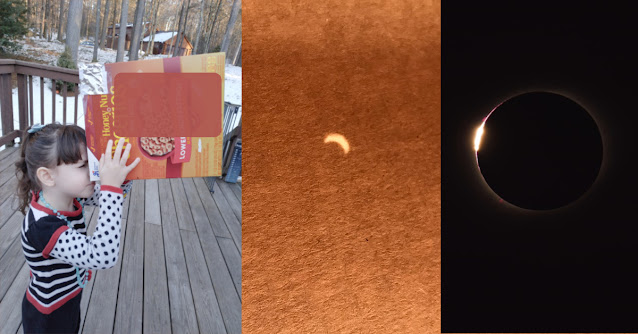
Another safe way to view an eclipse is to find a way to project the image of the eclipse somewhere else. One method is to make a pinhole camera, or pinhole projector. There are many easy ways to DIY your own. You can use the instructions here to make one out of a cardboard box.

Build a solar eclipse projector with me! If you have kids ages 8-11 then they can join me for my online class on solar eclipses. We will learn all about eclipses as well as how to view this one. Then we will make a solar eclipse projector out of common household materials. 
 
Check out more details for my class on Outschool- Solar Eclipse Science: Build Your Own Solar Eclipse Projector! here. (Even better, you may be able to enroll for FREE with my referral code or at a discount with my coupon code. You will find the codes and details here.) 

Outschool class build your own solar eclipse projector


When and Where to View Total Solar Eclipse 2024

 
On April 8th, 2024 the solar eclipse will pass over Mexico, the United States and Canada. The eclipse will reach Mexico's Pacific coast shortly after 11:00 AM, PDT. States in the U.S. that will experience a total eclipse include: Texas, Oklahoma, Arkansas, Missouri, Illinois, Kentucky, Indiana, Ohio, Pennsylvania, New York, Vermont, New Hampshire and Maine. 
 
You can learn more about the path and the timing for the total eclipse here on NASA's solar eclipse site.
 
You can also research when the eclipse will be arriving to your location on the Great American Eclipse site.
 
Even if you are not in the path of totality, you will witness a partial eclipse in any of the 48 contiguous states. It's sure to be a fascinating event! 

2024 Total Solar Eclipse NASA's Scientific Visualization Studio
credit: NASA's Scientific Visualization Studio
 

During the Solar Eclipse

 
During the total eclipse you will see the sky darken and it will seem like night time. The birds and other animals will stop making noise as if night has come. What a strange and beautiful experience!

Some people may witness the "diamond ring effect" which occurs just a few seconds before the Moon completely covers the Sun. For just a second there is a a ring shape and a flash of bright light on one side of it. Pink or reddish flickers are solar prominences, or little bursts of hot material that shoot out from the Sun.

If you will view a partial eclipse you will see the Moon's shadow pass over a portion of the Sun.
 
Eclipse Progression from Batam, Indonesia


What Exactly Happens During a Lunar or Solar Eclipse?

Are you excited for the solar eclipse on August 21st, 2017? We are! Read on to learn more about solar and lunar eclipses.

I know that astronomy can be a tough subject to teach, so I wanted to share a quick lesson idea for understanding what exactly is happening during an eclipse. There are two types of eclipses, lunar and solar, and both can be visible in the United States if the conditions are right. Visit my post, Exploring Lunar and Solar Eclipses on Only Passionate Curiosity blog, to see how you can create a quick visual model to understand both types of eclipses.

Before you head over to Only Passionate Curiosity, check out the supply list below to be sure you have what you need for this activity!

This post contains affiliate links, please see disclosures for details. 


Eclipse Visual Model Supplies


Eclipse Safety and other Celestial Events


Are you planning on watching the eclipse in August? Find out everything you need to know about viewing the solar eclipse here. 

Although the Sun's light is blocked out during an eclipse, it does not mean that it is safe to look directly at it! Find out how you can safely view a solar eclipse here. One option is to purchase solar eclipse glasses like the ones featured below.


You can also build a pinhole projector for safe solar eclipse viewing using this easy plan.  Or build a cereal box camera obscura with these directions instead.


Another fun astronomical event to view in the summer is the Perseid meteor shower in August. Find out how to best view the Perseid meteor shower with kids here.

Build a Pinhole Projector to View the Solar Eclipse!

Here is a quick DIY project to build your own pinhole projector. What is a pinhole projector? It is a simple device that allows you to project an image without looking directly at it. This is perfect for viewing a solar eclipse, since it is dangerous to look directly at the Sun, even when it is eclipsed. Building, designing, and engineering a pinhole projector is a great way to get kids engaged and excited to view the eclipse that will be visible across the United States on August 21st, 2017.

The design is simple and only uses a few materials that you most likely already have at home, in the kitchen or recycling bin. A great project for upper elementary or middle-school, or even younger kids with a bit of help from an adult.

Build a Pinhole Projector to Safely View the Solar Eclipse

This post contains affiliate links, please see disclosures for more information. 

You can find the directions for the pinhole projector on my guest contributor post on From ABCs to ACTs.

Build a Pinhole Projector to Safely View the Solar Eclipse

You'll probably also want to get some solar glasses, which can be purchased fairly inexpensively as well. (Regular sunglasses are not sufficient eye protection.) Check out these safe options from Amazon.


This way you can see how well your pinhole projector works, and then also view the eclipse through the glasses. Be sure to NEVER look at the eclipse with your naked eye, as it can cause permanent damage.

You won't want to miss our post on the details of the solar eclipse and everything you need to know about safe viewing. You can also explore the concept of eclipses to really understand what is happening with this quick lesson idea.


Not only is it exciting that the solar eclipse will be visible this summer, but it also provides a great summer vacation learning opportunity. We are so excited about eclipse viewing! Be sure to learn more to see if you'll see a total eclipse in your area!

Everything You Need to Know about the Great American Solar Eclipse!

For updated information on the April 2024 solar eclipse, visit this page! 

August 21st, 2017 is much anticipated for American astronomers and backyard stargazing enthusiasts. A total solar eclipse will occur, visible across the continental United States for the first time in almost 40 years! Although it is not a rare event for the Moon to temporarily block the Sun by moving between the Sun and the Earth, it is that it seldom happens where we can easily view it.

Read on to find the answers to your burning questions: What is an eclipse, exactly? Will I be able to see it where I live? How can I watch a solar eclipse safely? In addition to other educational astronomy resources.


This post contains affiliate links, please see disclosures for more information.   

What is an eclipse?


There are two types of eclipses, lunar and solar. As you may have guessed from the names, one has to do with the Moon and one with the Sun. A lunar eclipse occurs when the Earth passes between the Sun and Moon, blocking the Sun's light and casting a shadow on the Moon. A solar eclipse occurs when the Moon passes between the Earth and the Sun. In this case, the Moon blocks the Sun's light from reaching Earth. Check this link out for a simple lesson and visual modeling activity on eclipses.

Here's a diagram to help clarify this description. Notice how little of the Earth is affected by the Solar Eclipse in the top half of the diagram. This is why it is rare that we get a chance to see it. The Lunar Eclipse, in the bottom half of the diagram, is visible from any place on Earth that is facing the moon at that time. This is why it is easier to catch a glimpse of a lunar eclipse. 

Great American Solar Eclipse Safety and Learning Resources

The reason that the Sun appears completely eclipsed during a solar eclipse is that from Earth the Sun and the Moon are seen as the same size in the sky. Although the Sun is really much larger, their distances from the Earth give the appearance that they are the same size.

What Should You Expect to See on August 21st, 2017? 


If you reside in the contiguous 48 states of the U.S. you will be able to see at least a partial solar eclipse. A few lucky states will experience the total eclipse. For the path of the eclipse, and to find out where you'll be able to see it, check out this solar eclipse map. 


There are no major U.S. cities that fall in the zone of totality, or the area where the Sun will be completely eclipsed, however, if you live in Oregon, Idaho, Wyoming, Nebraska, Kansas, Missouri, Illinois, Kentucky, Tennessee, Georgia, or South Carolina, you might experience a total eclipse.

During the total eclipse the Moon will hide the Sun from view. When this happens, we can see the Sun's corona, the outer layers of plasma around the Sun. The corona will appear to be a beautiful ring of light around the edges of the Moon.

Great American Solar Eclipse Safety and Learning Resources
I, Luc Viatour [GFDL, CC-BY-SA-3.0 or CC BY-SA 2.5-2.0-1.0 ], via Wikimedia Commons

During the total eclipse, the sky will darken so that the stars will again be visible, and it will seem like it is night time. Even the birds and other animals will stop making noise and prepare for night. The experience is sure to be beautiful and strange at the same time!

Some people may see the beautiful "diamond ring effect" which occurs just a few seconds before the Moon completely covers the Sun. For just a second you can see a ring shape and a flash of bright light in one portion of it. You might also see pink or reddish flickers, that are solar prominences, or little bursts of hot material that shoot out from the Sun.

Viewers of the partial eclipse will still be able to see a portion of the Sun, but will be able to see the Moon's shadow move over at least a portion.

Whether you are viewing the total or partial eclipse, it is important to remember safety! We'll cover safe viewing later in this post.

The eclipse will only last about 2 and a half minutes. This is a relatively short eclipse, as they can last up to 7 minutes. The timing will depend on your location. It will be longest along the central line of the eclipse's path, and become shorter the further you are from there.

Depending on where you are viewing, and what time zone you are in, the eclipse will take place either in the morning or afternoon. For example, those in Salem, OR will begin to see the eclipse at 9:05 AM, whereas those watching in Columbia, SC will see it begin at 1:13 PM.

How to Safely View the Solar Eclipse


Watching a solar eclipse requires a little bit of planning. As you are aware, you should never look directly into the sun. An eclipse is no exception! DO NOT look directly at the eclipse with your naked eye and especially not through binoculars or a telescope as these only will magnify the sun's rays. Regular sunglasses do not provide enough protection for viewing the eclipse, even if it is just a partial eclipse!

Great American Solar Eclipse Safety and Learning Resources

So how can you safely view the solar eclipse?  The best option is to project the image of the sun somewhere else. You can do this by building a sun viewer, a pin-hole camera, or a solar funnel. These can all be built with simple materials, many of which you probably already have at home.

Build an easy pinhole projector with just a few materials for safe solar eclipse viewing, and a lesson in how light travels!

For other excellent tutorials and videos on building these devices, check out the Exploratorium's page on viewing a solar eclipse here. 

You might also investigate these options:

Another option is purchasing glasses designed for safe viewing of the eclipse. One option is this great pack from Celestron that is better for a family of 4 and includes an eclipse guide. Be sure you are purchasing a safe pair! (The brands we have linked to are safe.) Read this article to find out more! 


Solar Eclipse Learning Resources


Will you be teaching about the eclipse, watching it with your homeschool group, astronomy group or camp? You might consider this excellent solar science resource from the National Science Teacher's Association.There are also educational activities and links at NASA's eclipse site.

Many professional and amateur astronomers will be getting together for "solar eclipse viewing parties" on the big day. Here are 13 solar eclipse celebrations you might want to check out. Plan your own eclipse party with these tips from NASA. If you will be unable to view the eclipse in real life you can watch the live stream of the celestial event here.
Great American Solar Eclipse Safety and Learning Resources

If you're worried about missing this one, you'll get another chance on April 8th, 2024 when another solar eclipse will be viewed across the United States, this time passing through a different set of states.


Looking for other sun activities? Try building your own solar oven. Or these solar experiments for kids.

Have a space obsessed kid? Check out these great gifts for little astronauts and astronomers.


Observe the Supermoon Eclipse- September 27th, 2015


Solstice Lunar Eclipse (NASA, 12/21/10) NASA's Marshall Space Flight Center
Supermoon? Blood moon? Eclipse? It's only a few nights away- Sunday, September 27th, 2015. You'll want to try to see it because it won't happen again for another 18 years...but what does it all mean and how can you view it?

This video from NASA very succinctly and clearly shows what it means to have a "Supermoon" and a lunar eclipse.


Lunar eclipses are a great opportunity for star gazing. They are more "user friendly" than solar eclipses for several reasons. One is that you don't need protective eye gear to enjoy one! Another is that they are far more common because the shadow the Earth casts on the moon is much larger than the shadow the moon casts on the sun. This will be the fourth lunar eclipse in the past 2 years. 

"Pink" Full Moon and Partial Lunar Eclipse on April 25, 2013. image: NASA Goddard Photo and Video

Ok, we've got the supermoon and eclipse portion figured out- blood moon? That sounds ominous! The term, as far as science is concerned, has to do with the orange-red color of the moon during an eclipse. There are religious beliefs about the "blood moon" and its connotations, but we won't touch upon those here.

The moon turns this reddish color for the same reason we see these colors in sunsets and sunrises. The Earth's atmosphere works like a lens with a filter on it. It bends the red wavelengths of light and scatters the blue wavelengths. 

Get Ready for the Solstice Lunar Eclipse! (NASA, 12/19/10)
I hope you can get out and view at least part of the eclipse on Sunday, September 27th. For all sorts of information on when to look, check out this article from Earth Sky. The total eclipse begins at 2:11 Universal Time. You can convert UT to your time zone here.

Three of my favorite books for sharing the night sky with children and learning more myself are: (affiliate links) 
Chet Raymo's 365 Starry Nights : An Introduction to Astronomy for Every Night of the Year, 
H.A. Rey's The Stars
H.A. Rey's Find the Constellations. 


If you'd like to go high tech another excellent tool for orienting yourself to the night sky is Google's Sky Map app. With the app you simply hold your phone or device up toward the sky and it shows what you should be seeing in that location. However, I'd urge you to turn off your gadgets once you know what you're looking at and just enjoy!

If you like astronomy topics you might want to read my other posts that involve the sky and beyond by following this link.

Read more:
(affiliate link)
 

Total Lunar Eclipse- October 8th, 2014

The second of four eclipses in a lunar eclipse "tetrad" will occur over the course of the wee hours of October 8th. This tetrad of eclipses is unique in that each will be visible from parts of North America. We experience a lunar eclipse when the Earth passes between the sun and the moon causing Earth's shadow to block the sunlight from reaching the moon. Often these events take place but due to the timing we may not be able to see them. This is the second of the four that will take place in 2014 and 2015.

A lunar eclipse over Merritt Island, Florida (NASA)
    
     There are five stages to an eclipse that occur over the course of about three hours. The first is the penumbral stage, where the moon begins to enter the Earth's penumbra, or outer, lighter edges of shadow. Viewers might not notice changes in the moon at this point as the darkening is very slight. The second stage is the partial eclipse where the moon begins to enter the Earth's umbra, or the darker part of the shadow. The darkening will start on the moon's eastern side. The total eclipse is the third portion and this begins once the moon is directly in the darkest part of Earth's shadow, or umbra. The moon will glow red during the total eclipse due to sunlight. The moon moves back into a partial eclipse, and then finally back to the final penumbral stage as it moves out of Earth's shadow. Two factors will affect how dark the moon will look during the total eclipse portion: how deep into Earth's shadow the moon passes, and what the atmospheric conditions are at the time. For example, if there is a lot of dust in the atmosphere, then the moon will look darker. For those of us on the East Coast we will be able to see the total eclipse stage occur around 6:35 AM on October 8th. For a chart of the viewing times for other areas in North America, consult the link in the "read more" section below.
     It is not always possible to view astronomical happenings due to weather, obstructed views, light pollution and clouds. Luckily there are many good digital programs that model the night sky for us. One that could be particularly useful to teachers when having students observe and understand the phase changes of the moon is Stellarium. Stellarium is free, open source software that allows you to "view" the sky for any location and time. Although you won't be able to use it to experience the total lunar eclipse, you can observe the moon's phase changes in addition to seeing stars, planets, constellation charts, etc. from your own device. Stellarium software is even being used in some planetariums. Another free way to explore the moon is by using the moon option in Google Earth. Google Earth is useful for many educational purposes. You can explore the virtual moon globe and zoom into images of the craters and alien surface of our satellite. Although neither of these digital options is the same as heading outside with some binoculars on a clear night, they work well when there are obstacles for preventing you or your students from doing so. Happy sky-gazing!

Read more:

Moon and Sky Resources:
Stellarium free open source planetarium software

Google Moon- images and links to using Google Earth to navigate the moon

Sallie Ride MoonKam activities
Although the GRAIL MoonKam mission is over, there are many fun activities to try here!